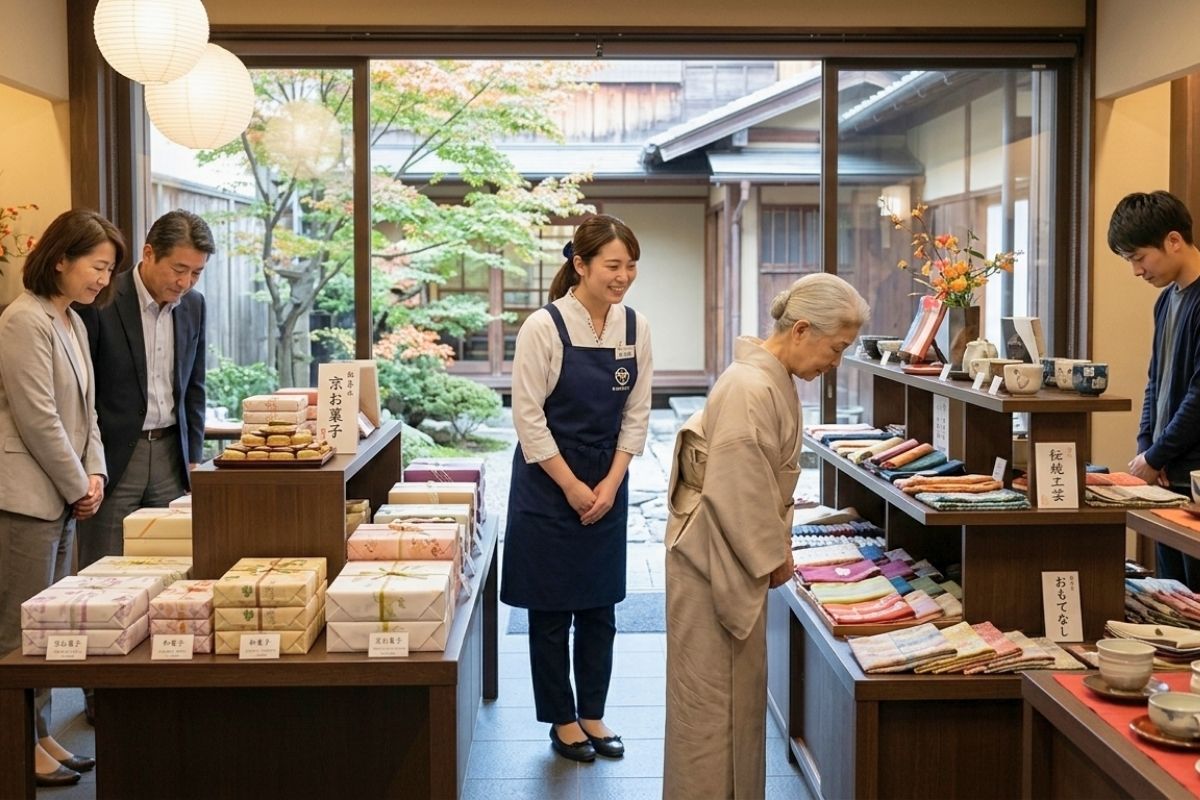
—— The Art of “Reading the Air” and the Silent Dance of Hospitality
Introduction: The Puzzling Silence
As you step through the automatic doors of a bustling Japanese department store or a quiet neighborhood boutique, you are immediately greeted by a chorus of energetic voices: “Irasshaimase!” It is a word that rings out like a bell, bright and welcoming. For many international visitors, this high-pitched, polite greeting is a hallmark of Japanese service.
However, as you watch the local shoppers, you might witness something confusing. Most Japanese people seem to walk past the staff without saying a word. They don’t say “Hello,” they don’t ask “How are you?”—they often don’t even make eye contact. To a traveler from a culture where an unacknowledged greeting is a sign of coldness or disrespect, this silence can feel like a snub.
“Why is everyone so rude to the staff?” you might wonder. “Are they invisible to these customers?”
As a mother who has lived through the changing tides of Japanese society, I want to pull back the curtain on this “Silent Dance.” What looks like a lack of manners is, in reality, a highly sophisticated form of mutual respect. In Japan, the distance between a shopkeeper and a customer is not a rigid rule; it is a fluid, living thing that changes based on the “air” of the moment.
1. “Irasshaimase” is Not a Conversation Starter
The first thing to understand is that “Irasshaimase” is fundamentally different from the English “Hello, how are you today?” In Western cultures, a greeting is a social contract—an opening of a door that requires a response to close the loop. If you don’t respond, you are breaking that contract.
In Japan, however, “Irasshaimase” is a “declaration of presence.” It is the staff’s way of saying, “I am here, I have recognized your arrival, and I am ready to serve you whenever you are ready.”
Because it is a one-way declaration of welcome, it does not strictly require a verbal response. When a Japanese customer walks past without speaking, they aren’t “ignoring” the staff. Instead, they are acknowledging the greeting through a “silent agreement.” By staying quiet, the customer is essentially saying, “I have heard your welcome, thank you. For now, please allow me the freedom to explore your shop in peace.”
If you look closely, you will see the subtle signs of response: a microscopic nod of the head (the “0.5-second bow”) or a slight softening of the eyes. This is the Japanese way of “closing the loop” without breaking the tranquility of the space.
2. The Mastery of “Reading the Air” (Kuuki wo Yomu)
The true genius of Japanese hospitality lies in a concept we call “Kuuki wo Yomu”—literally, “reading the air.” It is a form of high-level emotional intelligence that allows a shopkeeper to adjust their distance based on the customer’s “aura.”
In Japan, there is no “one-size-fits-all” service. Instead, the staff observes your body language, your pace, and your focus to determine exactly how much interaction you want.
The “Leave Me Alone” Aura
When a Japanese person enters a store just to browse, they emit a specific energy. They move slowly, their eyes wander across the shelves, and they maintain a protective bubble around themselves. A skilled clerk senses this immediately. They will continue to fold clothes or tidy shelves nearby, staying within reach but never intruding on the customer’s private thoughts. They understand that for many, shopping is a form of meditation. To interrupt that with “Can I help you find something?” would be a breach of etiquette.
The “I Need Help” Aura
The moment a customer’s behavior changes—perhaps they begin looking around for a staff member, or they compare two items with a puzzled expression—the “air” changes. In an instant, the clerk who seemed to be ignoring you will materialize at your side with a warm smile. Once the “boundary” is lowered, the interaction can become incredibly friendly. At the checkout counter, it is perfectly normal for Japanese people to engage in pleasant small talk. The distance is not cold; it is simply flexible.
3. Hospitality in Motion: The Mother’s Experience (Shosa)
As a mother who raised two children in this country, I have been saved countless times by the “innate kindness” of Japanese staff. I remember entering restaurants, exhausted, with a toddler in one hand and a diaper bag in the other. I never had to utter a single request.
Before I could even settle into my seat, a staff member would materialize—not because a manual told them to, but because the spirit of “Omotenashi” is ingrained in their very “Shosa” (refined gestures and conduct). They would bring a high chair with a practiced, graceful motion and provide a small set of colorful plates or a sticker book to keep my child occupied before the fussing could even begin.
This ability to “act before being asked” (先回り, sakimawari) is a hallmark of Japanese service. To us locals, it is a part of our daily landscape, but to those visiting from abroad, this “reaching out to an itch before you even feel it” service can seem like a form of magic. It is a kindness that is “worn” as a natural part of their professional identity.
4. The Customer’s Responsibility: Maintaining the Quality of Space
However, this incredible hospitality does not exist in a vacuum. It is not something the staff does for the customer; it is something the staff and the customer do together. In Japan, there is a deep-seated “silent awareness” that the customer also has a duty to protect the shared space.
While the staff goes above and beyond to accommodate a mother and her children, the parent also understands that it is their fundamental role to discipline and guide their children so as not to disturb the peace of other guests. In Japan, we do not subscribe to the idea that “I am a paying customer, so I can do whatever I want.” Instead, we view the public space as a shared garden that everyone must tend to.
This is what I call a “Mutual Aid Society” spirit. Every person present—the staff, the parents, and the other diners—cooperates to ensure that everyone can enjoy their time in their own way. This collective effort is the true reason why the “quality” and “tranquility” of Japanese public spaces are so consistently maintained. We help the staff help us.
5. Adaptability: The Gift to the Traveler
Japanese staff are masters of “Rinkiohen”—the ability to act according to the circumstances. They understand that a visitor from America or Europe may expect a more verbal, high-energy interaction.
You may find that when you enter a shop, the staff treats you with more overt friendliness than they would a local salaryman. They are trying to meet you at your cultural level. However, they are also waiting to see how you react. If you adopt the “Japanese style”—a quiet nod and focused browsing—they will give you the gift of silence. If you are bright and talkative, they will often do their best to mirror that energy. They are chameleons of courtesy, shifting their colors to make you feel at home.
6. Why Japan Is Like This? ―― Q&A for the Mindful Shopper
Q: I feel so guilty just nodding. Can I say “Hello” back?
A: Of course! If you want to be extra polite, a small “Konnichiwa” or even a whispered “Domo” while nodding is perfectly lovely. It won’t be seen as strange; it will be seen as very kind.
Q: Does the staff feel insulted when people don’t say anything?
A: Not at all. To them, a customer who shop silently and follows the rules of the store is a “Good Customer.” Your silence is interpreted as a sign that you are comfortable.
Q: I’m with my kids and they’re being a bit loud. Is the “Omotenashi” gone?
A: Never. The staff will likely be even more attentive to help you. The “Japanese way” is to show your effort. If the staff sees you trying to maintain the “Wa” (Harmony), they will go above and beyond to support you.
Q: What is the best way to say “Thank you” when leaving?
A: As you leave, a simple “Arigato gozaimasu” or even just “Gochisosama” (after a meal) is a beautiful way to acknowledge the effort.
Closing Thoughts: The Beauty of the Unspoken
The Japanese “distance” is not an absence of warmth; it is a refined form of care. It is built on the belief that sometimes, the greatest gift you can give a stranger is the freedom to be “invisible” and at peace.
Our “Omotenashi” is a bridge. On one side is the staff’s Shosa (gestures), and on the other is your Respect. When both meet in the middle, even without a single word, that is when the magic of Japan truly happens. We are all caretakers of the air we breathe together.

[English] A local insider born in Nagasaki, educated in the U.S., and now based in the Kanto region. After a career in finance and publishing in Tokyo, I now explore the “Why” behind Japanese culture and hidden regional gems. My mission is to help you discover the authentic heart of Japan beyond the tourist crowds.
[한국어] 나카사키 출생, 미국 유학을 거쳐 도쿄 금융권 및 편집자로 활동한 현지인 에디터입니다. 현재 관동 지역에 거주하며 후쿠오카를 비롯한 일본 전역의 ‘진짜’ 매력과 독특한 문화 이야기를 전합니다. 여러분의 여행이 더욱 깊어지는 길잡이가 되겠습니다.