―― The Science of “1/f Fluctuation,” the Heart of “Otaga-i-sama,” and the Silent Rules of the Rails
Introduction: The Mystery of the Sleeping Commuter
Have you ever looked out the window of a shinkansen or a local commuter train in Tokyo and felt as though you had stepped into a quiet, animated masterpiece? If you are an anime fan, you’ve likely seen scenes where characters fall fast asleep, surrendered to the gentle swaying of a train carriage. But when you visit Japan for the first time, the reality often hits you with a sense of shock.
In the middle of the world’s most crowded commute, people are sleeping. They are standing up, leaning against doors, or even resting their heads on the shoulders of complete strangers.
“Don’t they worry about their wallets being stolen?” “Is it okay to lean on the person next to you?” “How can a nation so famous for its work ethic be so comfortable sleeping in public?”
As a mother who has raised two children in this society and seen the changing face of Japan over decades, I want to invite you into the heart of this mystery. The Japanese train is not just a mode of transport; it is a “special sanctuary” where a history spanning over 2,700 years meets modern science. This is the story behind the small miracle we call “Inemuri” (sleeping while present).
1. The Science of the “Moving Cradle”: Why Your Brain Relaxes
Why is it that the moment we sit on a Japanese train seat—especially on a warm afternoon—an irresistible drowsiness washes over us? It isn’t just exhaustion from work. The key lies in a fascinating scientific rhythm called “1/f Fluctuation” (1/f yuragi).
A Return to the Womb
Think back—or imagine—the very first sensations of life. Scientific research suggests that the vibration of a Japanese train, which clocks in at roughly 1Hz (once per second), closely mimics the heartbeat and the gentle swaying of amniotic fluid that a baby feels inside the mother’s womb.
When you are on a train, you aren’t just moving forward. You are being swayed in a complex 3D pattern: up, down, left, right, and a subtle rotation. To our primal instincts, this movement whispers, “You are safe. You are protected.” This triggers the parasympathetic nervous system, effectively switching the brain from “High Alert” to “Rest Mode.”
The Difference Between Local Lines and the Shinkansen
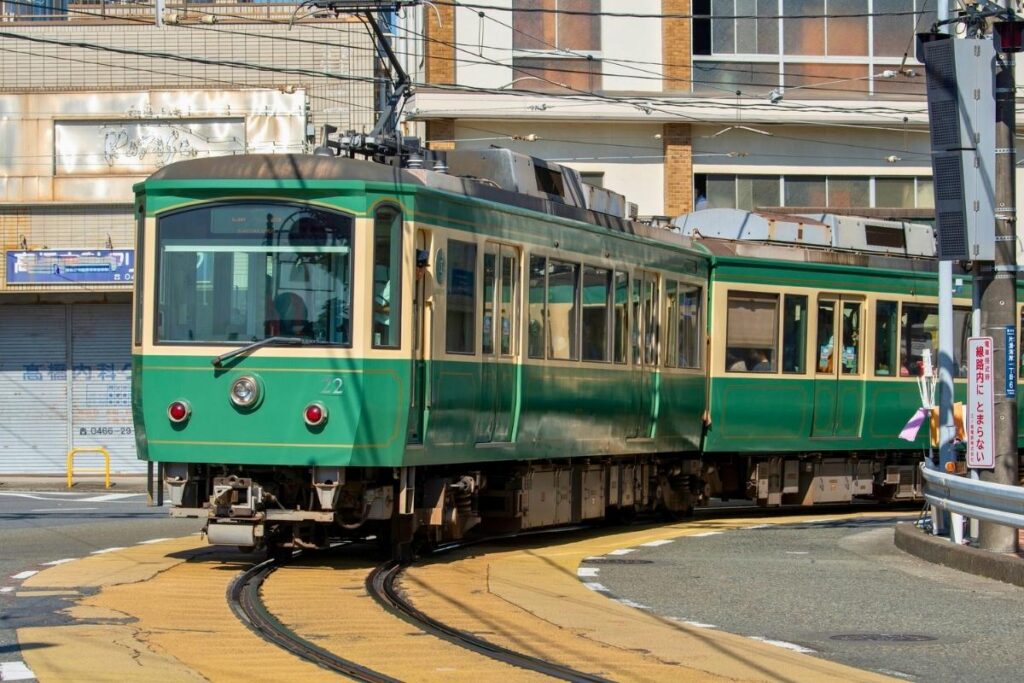
Interestingly, many people find it easier to nap on local lines (Zairaisen) than on the high-speed Shinkansen. This is because the Shinkansen is engineered to be as smooth as possible, whereas local lines have the rhythmic “clack-clack” of the rails and the swaying of curves. These “imperfections” are exactly what create the 1/f fluctuation.
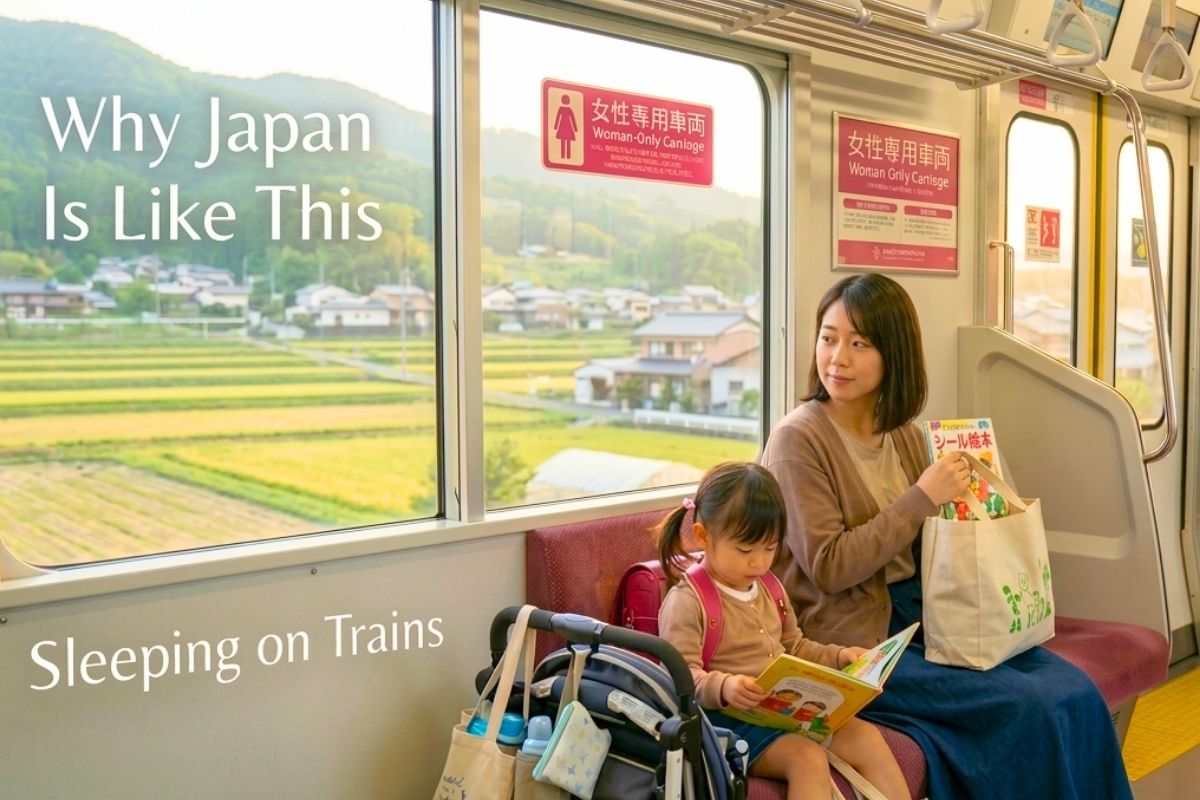
Furthermore, the scenery outside—the suburban houses, the small rice fields, and the distant mountains—acts as a “moving animation.” For travelers, it feels like a Ghibli movie come to life. For us locals, it is a visual lullaby that softens the stress of the day.
2. The Heart of the Journey: Memories of Motherhood
To understand why we allow ourselves to be so vulnerable on a train, you have to understand the invisible threads that hold our society together. We call this “Otaga-i-sama” (the spirit of “we are in this together”).
I will never forget the years I spent navigating the Tokyo rail system with my two children. Imagine this: a heavy stroller with a sleeping baby, a four-year-old who is starting to get restless, and a train carriage that is slowly filling up. My heart would pound with anxiety.
“What if they start crying?” “What if my stroller is in someone’s way?”
Like many Japanese mothers, I prepared for these trips with the precision of a general. My bag was filled with “emergency kits”—new stickers, quiet picture books, and soft plushies. This effort wasn’t born out of fear of being yelled at; it was born out of a deep-seated respect for the shared space. I wanted to move through the world “smartly” and gracefully, without placing a burden on others.
However, life with children is unpredictable. When my kids did have a meltdown, I was often met with something beautiful. A “veteran mother” or a grandmotherly figure would catch my eye and give a small, knowing nod. Sometimes they would offer a seat or simply say, “You’re doing a wonderful job.”
Those moments taught me that the silence of the Japanese train isn’t a “cold” silence; it is a “protective” silence. We give each other space because we know how hard everyone is working. Now that my children are grown, I look at young mothers struggling and I feel a rush of affection. I think, “I remember that weight. You are not alone.” If they need help, I am there. We are a community that raises children through a silent, collective understanding.
3. The Etiquette of Silence: The “Invisible Boundary”
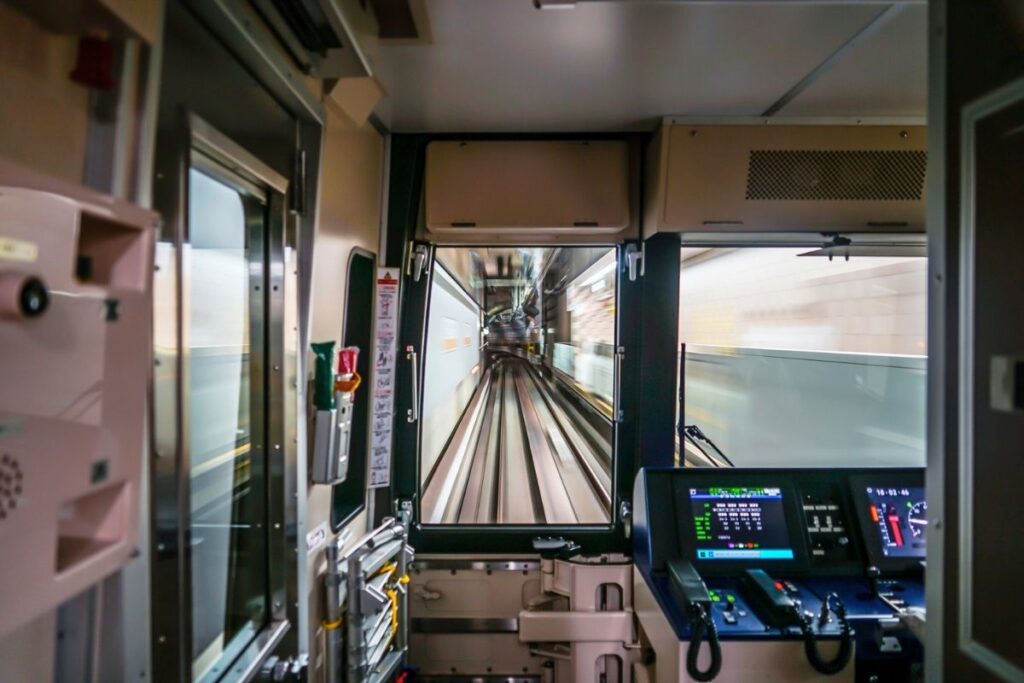
To a visitor, a crowded Japanese train might feel oppressive, but to a Japanese person, it is often a place of deep mental focus. We respect the “Invisible Boundary” of sound and space.
The Morning Ritual: Preparing the Soul
In the morning, the train is a sacred space for “re-centering.” You will see people checking the news, answering emails, or simply staring into space. They are not being “anti-social”; they are preparing their souls for the demands of the Japanese workplace.
The Golden Rule: No Sound Leakage
You will notice almost everyone has headphones in, yet you hear nothing. The rule of “no sound leakage” is a core tenet of our etiquette. The logic is simple: “My enjoyment must not become your discomfort.” By keeping our music and our voices quiet, we create a sanctuary where a stranger can feel comfortable enough to close their eyes and rest.
The Evening Sanctuary: The Bridge to Home
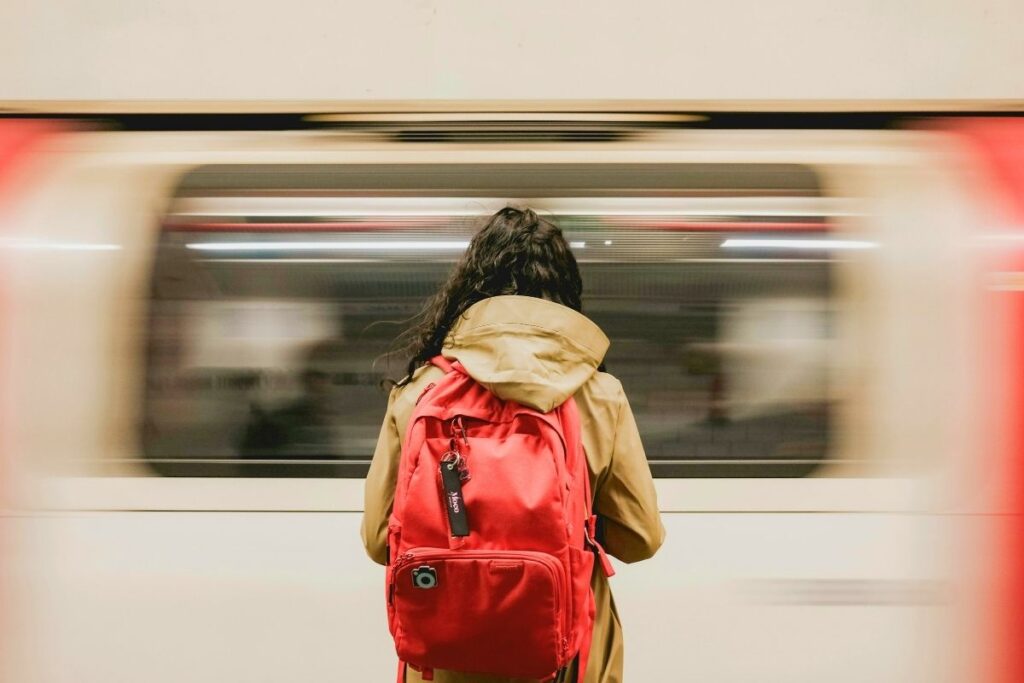
On the way home, after long hours of work or study, the train becomes a “liminal space”—a bridge between the pressures of the world and the peace of home. This is when the “shoulder nap” happens. If a stranger leans on you, the typical Japanese response isn’t anger; it’s a quiet acceptance. “They must be so tired,” we think. This “awkward but kind” tolerance is the highest form of Japanese “Wa” (Harmony).
4. A Plea for Respect: Protecting a 2,700-Year Legacy
Because we are so welcoming, it hurts us deeply when our “sanctuary” is disrespected. We love seeing visitors enjoy our country, but recently, a new and troubling trend has emerged.
We have seen “influencers” using hand straps for pull-ups, or groups of tourists occupying an entire carriage to perform loud dances for social media. To a Japanese observer, this feels like someone walking into your living room with muddy shoes and jumping on the furniture.
Our peace is not an accident. The safety that allows you to carry a wallet without fear, and the silence that allows a mother to breathe, are results of 2,700 years of history. We have been taught to be humble, to be quiet, and to consider the person standing next to us. When these rules are broken for a “viral video,” it feels as though our very history is being mocked.
Respect is the currency of cultural exchange. We ask you to enter our world not as a stage for a performance, but as a guest in a long, quiet tradition.
5. Why Japan Is Like This? ―― Q&A for the Modern Traveler
To help you navigate your journey, here are some of the most common questions I receive from travelers:
Q: Is it actually okay if I fall asleep and lean on someone?
A: While we try to avoid it, it happens! If you wake up on someone’s shoulder, don’t panic. A small bow and a whispered “Sumimasen” (I’m sorry/Thank you) is all that is needed. We understand the “1/f fluctuation” caught you!
Q: Why can’t I talk on my phone? Everyone else is on their phone!
A: You can use your phone, but you shouldn’t talk on it. The sound of a voice—especially in a language others might not understand—breaks the collective “rest mode” of the carriage. Texting is perfectly fine.
Q: I’m traveling with kids and they are crying. Should I get off the train?
A: If they are inconsolable, stepping off at the next station to catch your breath can be helpful for your stress levels. But know that most people (especially mothers like me!) are not judging you. We are cheering for you silently.
Q: Why are there “Women Only” carriages?
A: These were created to provide a safer environment during the intense crush of rush hour. Please respect these signs (usually pink) during the designated morning and evening hours.
Closing Thoughts: Passing the Baton of Harmony
I am proud to have been born in a country that values the “unspoken word” and the “shared silence.” I want to pass down these beautiful landscapes and these gentle habits to the next generation.
If you see someone sleeping on a train in Japan, remember: it is a sign that they trust their neighbors. It is a sign of a society that, despite its high-tech surface, still values the primal peace of the cradle.
Our “Welcome” to you is sincere and deep. If you can receive our culture with a little “Respect” and a “Humble heart,” you will find that Japan opens up to you in ways you never imagined. May your journey through our beautiful islands be as peaceful and warm as the swaying of our trains.
About the Author: A mother who raised two children in the heart of Japan. I writes to bridge the gap between traditional Japanese etiquette and the curiosity of the modern world, ensuring that the “Spirit of Wa” is felt by every visitor.

[English] A local insider born in Nagasaki, educated in the U.S., and now based in the Kanto region. After a career in finance and publishing in Tokyo, I now explore the “Why” behind Japanese culture and hidden regional gems. My mission is to help you discover the authentic heart of Japan beyond the tourist crowds.
[한국어] 나카사키 출생, 미국 유학을 거쳐 도쿄 금융권 및 편집자로 활동한 현지인 에디터입니다. 현재 관동 지역에 거주하며 후쿠오카를 비롯한 일본 전역의 ‘진짜’ 매력과 독특한 문화 이야기를 전합니다. 여러분의 여행이 더욱 깊어지는 길잡이가 되겠습니다.