[Introduction]
Welcome back to J-Context | The Japan Logic.
In our first episode, Ren began his journey by slipping through the cracks of time, discovering that history is not just a collection of dates, but a living breathing story. But have you ever wondered why Japanese people feel such a deep, unspoken connection to nature? Why, in the middle of a neon-lit metropolis like Tokyo, do we still find quiet forests guarded by sacred ropes?
In this second installment, Ren visits Suitengu, a shrine famous for protecting mothers and children. There, he encounters a mysterious guide named Morinoko, who reveals a fundamental secret of the Japanese heart: the difference between a world that is “made” and a world that simply “becomes.”
If you have ever stepped through a torii gate and felt a sudden, inexplicable sense of peace, this story is for you. Let’s dive deep into the Jomon spirit and discover the true meaning behind the clap of our hands.
1. A Sanctuary Hidden in the Asphalt Jungle
Tokyo’s afternoon is a relentless tide of noise. The metallic screech of trains, the hum of millions of tires on asphalt, and the hurried footsteps of people chasing a clock that never stops. For Ren, a modern boy born into this digital age, this cacophony was the soundtrack of existence.
However, as he stepped through the torii gate of the “Suitengu” shrine, the world suddenly lost its color—or perhaps, it found it.
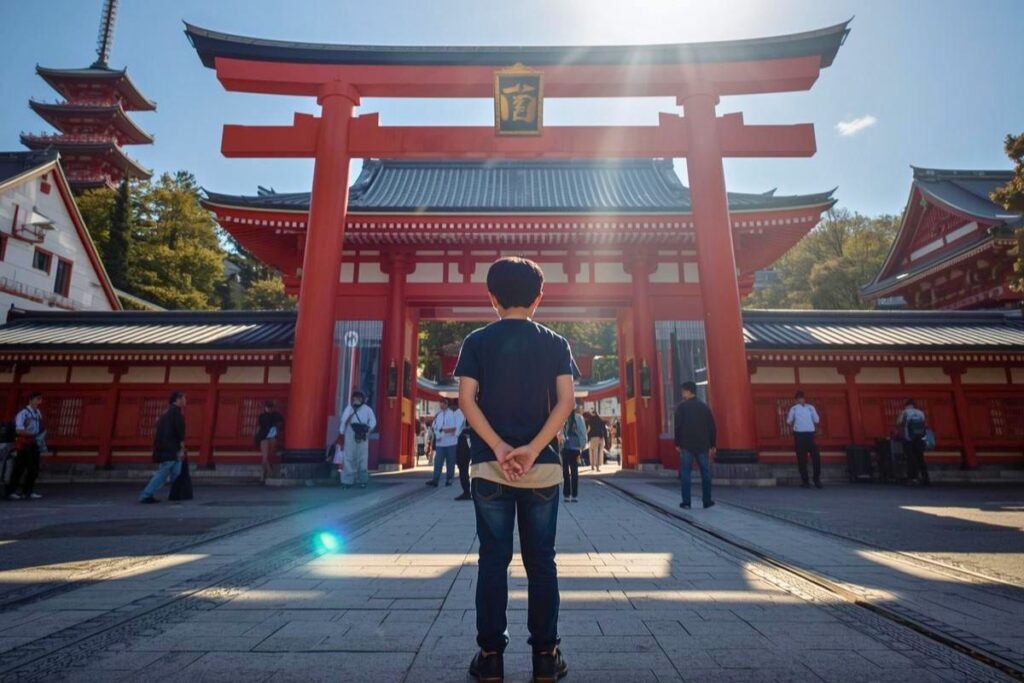
This was the place his mother had visited before he was even born, praying for his safe arrival into the world. Surrounded by towering skyscrapers of glass and steel, the shrine felt like a pocket of stagnant time, where the air was noticeably cooler and carried the faint, sweet scent of incense and ancient wood.
“This is it…” Ren whispered.
His eyes were drawn to the massive shimenawa—a sacred straw rope—wrapped powerfully around the thick pillars of the main hall. Golden-hued straw, twisted with precision, adorned with zigzagging white paper streamers called shide that fluttered like ghost wings in the breeze.
Since his first strange journey, Ren had become sensitive to these “boundaries.” He felt a magnetic pull.
“Is someone waiting here, too?”
As his fingers brushed the rough, sun-dried texture of the straw, a violent vibration surged through his arm. The roar of the city vanished, swallowed by a deep, verdant darkness. Ren’s consciousness plunged into a primordial abyss of green.
2. Witnessing the “Becoming”
Ren opened his eyes to a world of milky white mist. There was no sky, no horizon—only the feeling of soft moss beneath his feet that pulsed with a faint, rhythmic heartbeat.
“I can’t see anything… Where am I?”
“Stay calm, Ren. This is the deepest layer of memory—the place before this island even had a shape.”
The voice sounded like the dry rustle of autumn leaves. Ren spun around to find a small figure. It was a boy, yet he looked like he had stepped out of the earth itself. He wore clothes textured like ancient tree bark and a cap made from a giant acorn.

“I am Morinoko,” the boy said, his eyes reflecting thousands of years of starlight. “I am the custodian of the forest’s memory. You were trying to hear the voice of the Great Tree, weren’t you?”
Morinoko was different from the guide Ren had met before. He was slower, more deliberate, as if every word he spoke had to grow from his lungs like a sapling.
“Ren, in the world you come from, how were you taught the world began?”
Ren thought for a moment. “In school… and in books… I heard that a Great Creator fashioned the world from nothing. Like a sculptor molding clay into people and animals. Like building a house.”
Morinoko sat at the root of a misty tree and smiled gently. “I see. That is the concept of ‘Creation’—the idea that someone from the ‘outside’ made the world. But this island is different. We believe the world was not ‘made.’ It ‘became’ (Naru).”
Morinoko tapped his staff against the ground. The mist cleared instantly, revealing a terrifyingly beautiful sight.
The earth began to heave and buckle. Mountains surged upward like waves, and from the cracks in the stone, a torrent of life erupted. This was not a controlled design. It was a wild, spontaneous bursting—like a seed exploding into a forest.
“The gods themselves,” Morinoko whispered, “emerged from that same surge of life, just as humans did. To us, the world is not a ‘work of art’ made by a god. The world is the life. The gods, the trees, the rocks, and the humans—we are all part of one massive, living family, born from the same pulse.”
3. The Jomon Prayer: Shimenawa as a Bridge
The scenery shifted like a rushing river.
Suddenly, Ren was standing in a primeval forest so dense that the sun only reached the ground in thin, shimmering needles of light. This was the Jomon Period, thousands of years in the past.
There were no grand buildings, no golden roofs. Yet, Ren saw people gathered before a colossal tree and a strangely shaped boulder.
“They don’t have shrines yet,” Morinoko noted, “but they know exactly where the life-force is strongest.”
The people were winding vines around the giant tree.
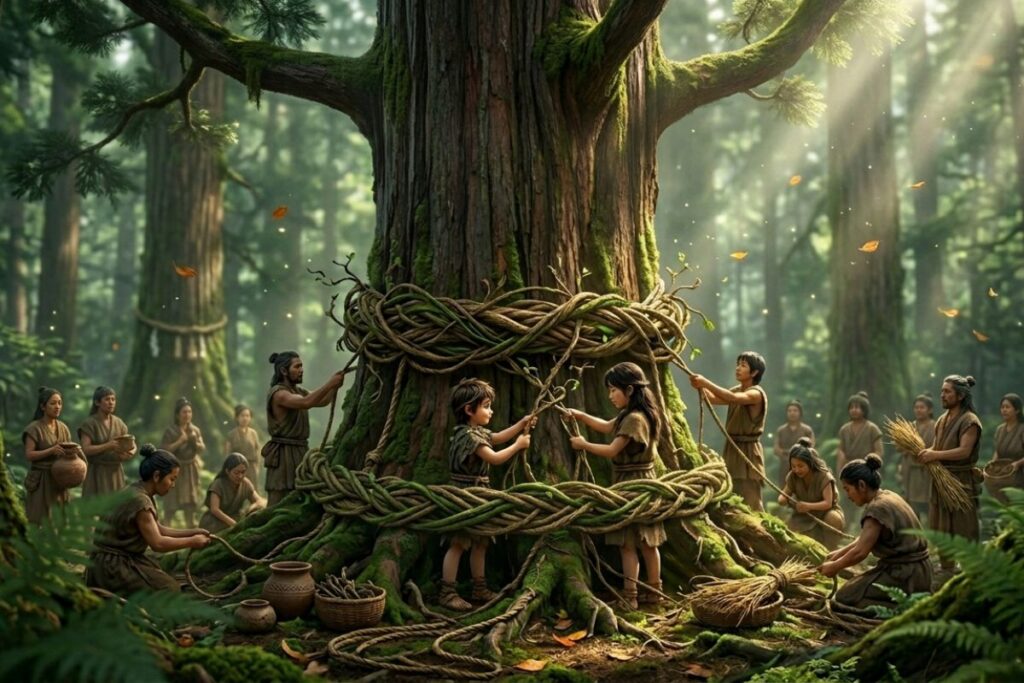
“That,” Ren realized, “is the ancestor of the shimenawa.”
“Indeed,” Morinoko said. “It is a boundary. A sign that says: This life is sacred. Humans recognized that trees, which live for centuries and support the sky, are the primary vessels of the world’s spirit. The shimenawa was never a decoration. It was a gesture of profound respect—a bond between humans and the source of life.”
4. Yayoi to Edo: The Evolution of Gratitude
Time accelerated. Ren saw the Yayoi Period, where people began to cultivate rice and pray to the water.
“The gods are not in a distant heaven,” Morinoko’s voice echoed. “They are in the water that wets the fields, the wind that carries the seeds, and the very bodies of the people. This is Yaoyorozu—the Eight Million Gods. It means that everything has a spirit, and nothing is without value.”
Then, the world transformed into the vibrant colors of the Edo Period.
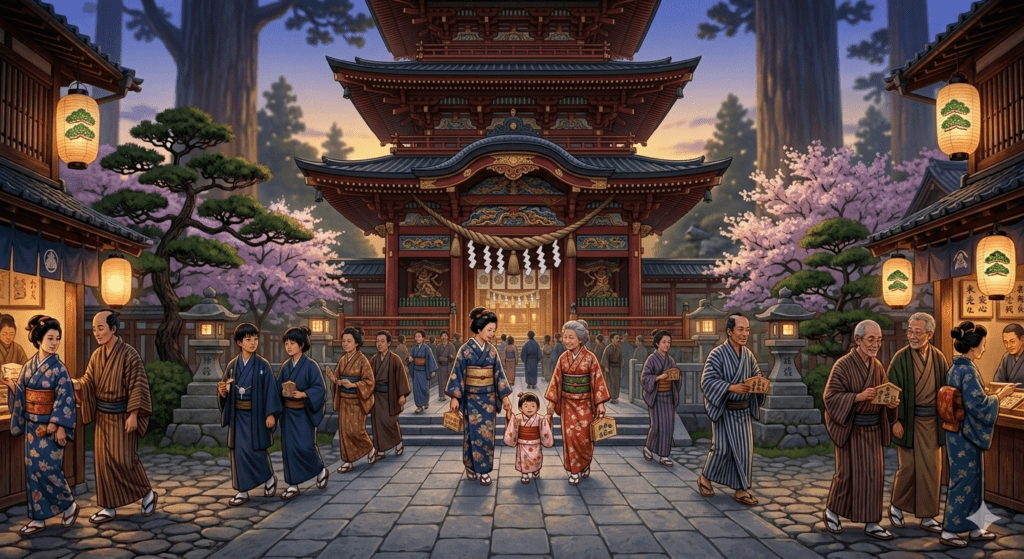
Beautiful shrines with intricate carvings now stood where the ancient groves once were. People in kimonos hurried through the gates—some to pray for success in exams, others for the safety of a new child.
Ren watched a man stand before the altar. The man purified his hands with water, rinsed his mouth, and then stood perfectly still. He tossed a coin into the box, bowed twice, clapped his hands twice, and then closed his eyes.
“Morinoko… what is he asking for? Money? Success?”
Morinoko shook his head. “Look closer, Ren. His heart isn’t full of demands. He isn’t saying ‘Give me this.’ He is acknowledging that he is alive today, and that those he loves are safe. He is here to ‘Report’ and to ‘Thank’.”
“To thank?”
“Yes. In Japan, a shrine is not a place where you go to ask for magic. It is a place where you return to yourself—where you remember that you are a small part of a vast, natural harmony. To join your hands together is a ritual to harmonize your heart with the spirit of the world. To be humble. To trust the flow. That is the true strength of the Japanese people.”
5. The Warmth in the Pocket
“Ren, remember this. Even in your era, when people visit shrines for the New Year or when a child is born, they are following an ancient rhythm. It is a ‘Memory of Gratitude’ flowing in their blood, calling them back to the forest.”
Morinoko’s voice began to fade into the sound of the wind.
When Ren opened his eyes, he was back at the Suitengu shrine. The evening sun was painting the skyscrapers in hues of orange and gold.
Beside him, a young woman with a small child was bowing silently. Her expression was incredibly peaceful. Ren understood now: she hadn’t come to demand a miracle; she had come to say “Thank you” for the miracle that was already in her arms.
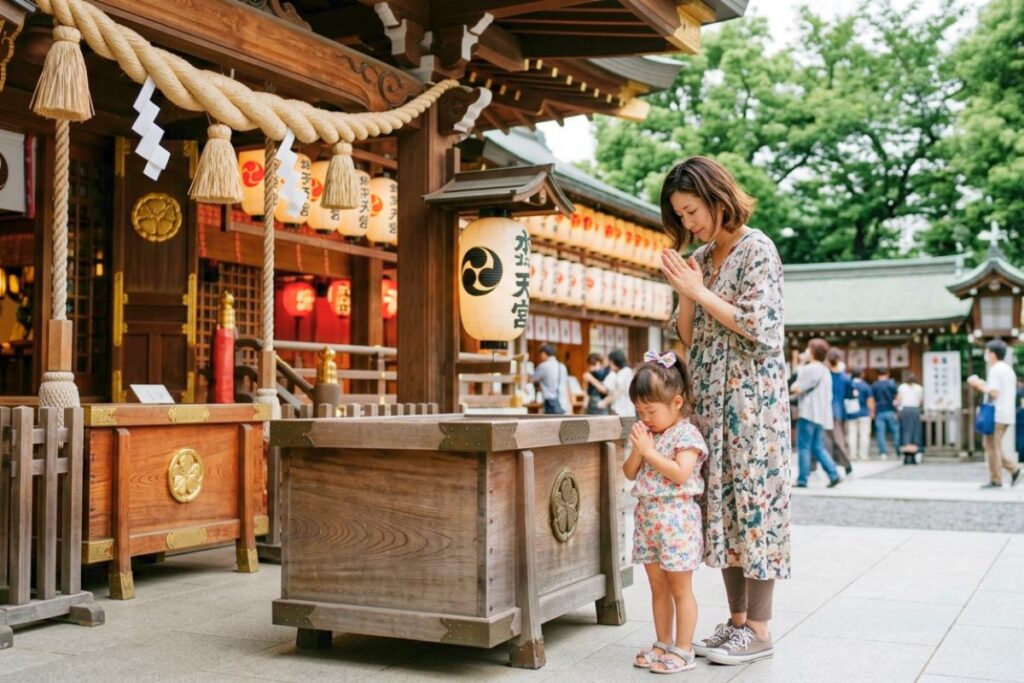
Ren walked to the altar. He purified his hands. He stood before the shimenawa.
Clap. Clap.
(Thank you for the life that brought me here.)
As he prayed, he felt a small, hard object in his pocket grow warm. It was the acorn he had found in the forest of the past—a physical echo of a world that never truly ended.
💡 Learning Section: The Wisdom of the Forest
In this episode, Ren discovered the profound roots of Japanese spirituality. Let’s break down the key concepts:
1. “Becoming” (Naru) vs. “Creating” (Tsukuru)
While many Western philosophies view the world as something designed and “made” by a transcendent creator, Japanese thought emphasizes that the world “became” or “emerged” naturally. This leads to a worldview where humans are not the masters of nature, but rather its younger siblings.
2. Why Shrines are Forests
Every shrine is surrounded by greenery because the trees themselves are the Yorishiro—the physical vessels where spirits reside. The shimenawa (sacred rope) marks the boundary of this sacred space, reminding us to enter with a quiet heart.
3. “Reporting” instead of “Requesting”
A common misconception is that Japanese people go to shrines to ask for favors. In reality, the essence of prayer in Japan is Reporting (Hokoku) and Gratitude (Kansha).
- New Year’s: Reporting the safe passing of a year.
- Shrine Visits for Children: Reporting a birth and thanking the spirits for protection. By saying “Thank you” instead of “Give me,” one aligns their spirit with the harmony of the universe.
✍️ Epilogue: The Author’s Reflection — The Kami in Our Daily Lives
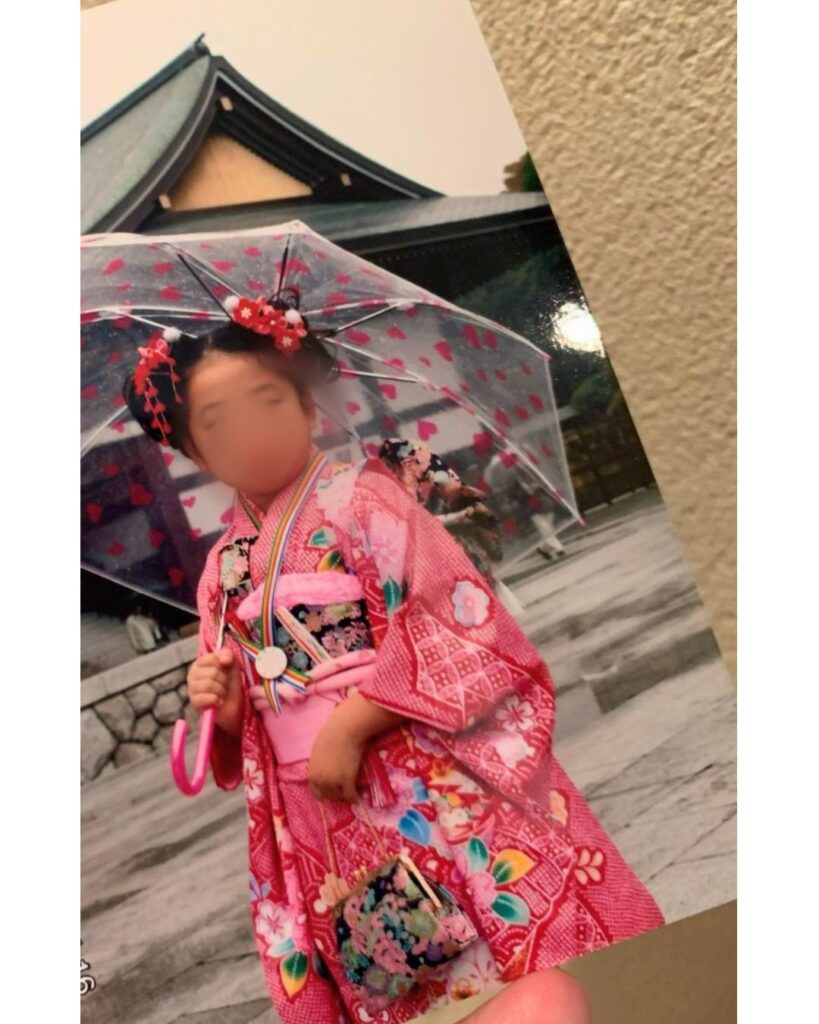
I was born in the Showa era, raised as a typical Japanese person. For us, shrines were never “special” in a religious sense—they were simply the scenery of our lives.
As a child, I remember the crisp air of New Year’s morning as my family walked to our local shrine. I remember the weight of the Chitose-ame (long candy) in my hands during my Shichi-Go-San ceremony. Before my exams, I went to Dazaifu Tenmangu to stand before the spirit of Sugawara no Michizane, asking for his watchful eye. And before I became a mother, I stood at Suitengu, just like Ren, praying for the life within me.
To an outsider, it might seem like we have no religion. But the truth is that our spirituality is so deeply woven into our habits that we don’t even call it “faith.” It is simply how we live.
There is one point I wish for the world to understand: when we bow at a shrine, we are not asking for a magical shortcut to success.
The act of washing our hands, ringing the bell, and clapping is a way to recalibrate our hearts. We are quieting the noise of the modern world to say: “I have done my best. Now, I leave the rest to the great flow of nature. Thank you for watching over me.”
This humble “trusting of the flow” is the heart of Japanese Omotenashi and harmony. If this story inspires even one person to step through a torii gate and whisper a silent “Thank you” to the trees, then Ren’s journey has served its purpose.
Foreshadowing for the Next Episode
- The acorn in Ren’s pocket is changing. It seems to glow brighter every time he learns a new truth about his heritage.
- Next, Ren will find himself in the era of master craftsmen—a time when even a simple tool was believed to have a soul.
- Who are these “Morinoko” guides? Ren is beginning to realize they look strikingly like the small wooden carvings his grandfather used to collect…
「Read Episode 1 here」
「Read Episode 3 here」

About the Author
A native Japanese creator and passionate traveler born in Nagasaki and currently residing in the Kanto region. After studying in the U.S. during high school and working for a U.S. financial institution, she transitioned into the Japanese publishing industry, gaining a unique perspective on how to bridge cultures.
As a mother of two who has traveled extensively across Japan and to over 15 countries—from Egypt to Switzerland—she believes that understanding a nation’s underlying values is the key to global harmony. Through this site, she blends her love for storytelling and Japanese heritage to share the timeless morals and “Omotenashi” spirit with children and families worldwide.