Introduction
In the modern world, we are bombarded daily with words like “sustainability” and “SDGs.” But did you know that nearly 200 years ago, there existed a city that had already perfected a flawless zero-waste society? That city was Edo (modern-day Tokyo).
Under the isolationist policies of the Shogunate, the people of Edo faced severe resource constraints. Yet, they didn’t just “save” or “endure”—they thrived by creating a world where nothing was ever truly discarded. At the heart of this was the Japanese logic of “Mottainai.” It is a philosophy that views objects not as mere “things” to be consumed, but as “partners” that possess a soul.
Following his encounters with the ancient “Becoming” world and the gratitude of shrines, our protagonist Ren now steps into the bustling alleyways of the 18th century. Here, a single kimono eventually becomes ash, which in turn feeds the soil to grow new life. Let us journey into the “Circle of Life” that Edo perfected—a logic of abundance that we are only just beginning to rediscover.
1. The “Masterpiece” of the Old Workshop
A few days had passed since Ren’s visit to Suitengu, and he had settled back into the familiar rhythm of his daily life. Yet, in the back of his mind, he couldn’t stop thinking about the acorn. He felt certain that the tiny seed held the key to some great destiny.
One day after school, on a sudden impulse, Ren made his way to an old woodworking workshop on the edge of town. It was a place where time seemed to stand still, run by a craftsman who had once been a close friend of his grandfather.
Deep inside the workshop, Ren sat before a workbench lined with well-used planes (kanna) and chisels (nomi). The faint scent of sawdust and the golden twilight filtering through the window created a serene, heavy silence.
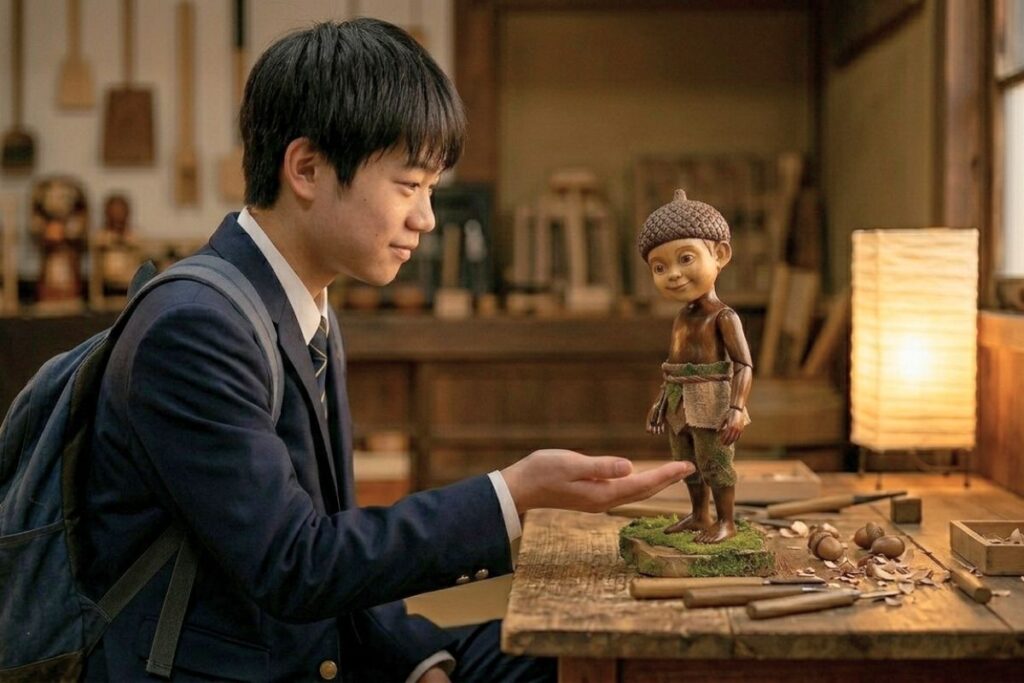
Ren found himself staring intently at a single figure resting on the workbench. It was no longer the simple acorn that had been in his pocket only days ago.
“Is it… you?”
As if responding to Ren’s voice, the figure began to move—slowly, but with a distinct, conscious will.
Standing there was a tiny boy, no more than 15 centimeters tall. However, his appearance was fundamentally different from the wooden spirit Ren had met before. His skin possessed the deep, polished luster of aged timber, a rich patina built over hundreds of years. He looked like the very embodiment of a masterpiece, carved by a master’s hand and imbued with a soul over vast reaches of time.
On his head, he wore a small cap, perfectly modeled after that acorn shell. Only the simple, brown fabric he wore felt soft to the touch, fitting his wooden body naturally.
This was more than just the evolution of a spirit. It was the physical form of a heart that cherishes objects—a true “Masterpiece.” The little wooden boy looked up at Ren from the workbench, returning his gaze with a quiet yet powerful intensity.
2. A City Without the Concept of “Waste”
“Ren, this time you have reached the ‘memories of things with form’.”
Beside him stood Morinoko, just as before. Yet, his appearance remained transformed from the previous episode—he carried that deep luster of aged wood and wore his craftsman’s acorn cap with pride.
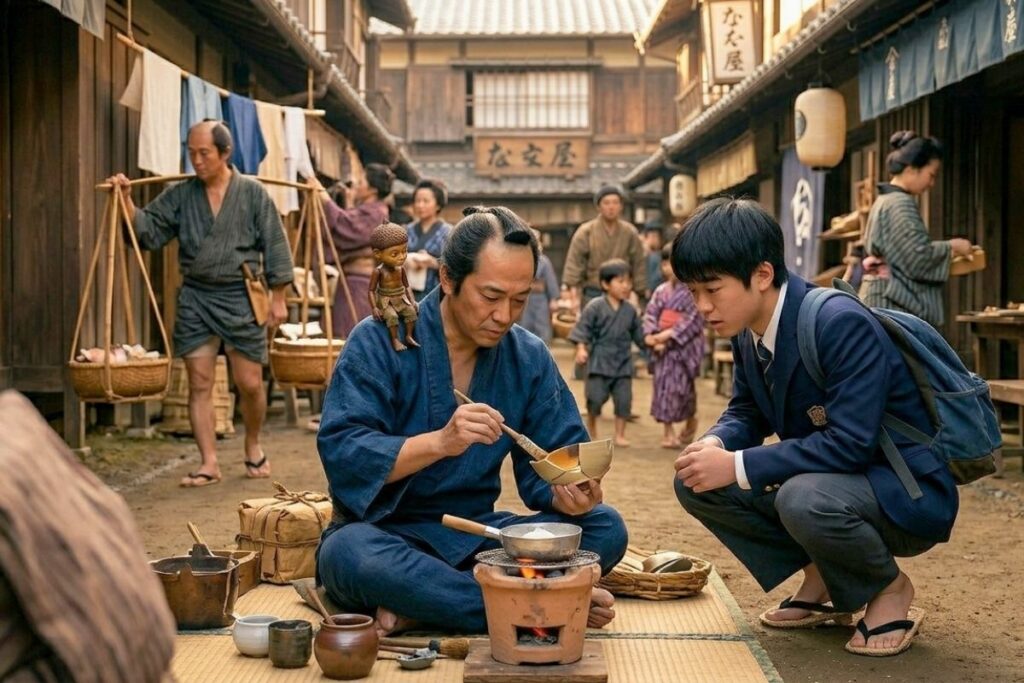
Ren opened his eyes to a lively alleyway in the Edo period. A bright blue sky was framed by laundry hanging on poles, and the air was thick with the rhythmic cries of street vendors. What struck Ren most was the cleanliness; everything looked old and well-worn, yet absolutely nothing looked like “trash.”
“Look closely, Ren,” Morinoko said. “In this city, the very concept of a ‘garbage dump’ does not exist.”
A man carrying a wooden chest on a shoulder pole sat down nearby. “Bowls to mend! Ceramic mending here!”
He was a Yakisugi-ya, a mender of ceramics. Ren watched as he meticulously joined broken shards using a paste of rice flour and lead, heating it with a small bellows to fuse the pieces back together.
“Why bother?” Ren asked. “In my time, it’s much faster to just buy a new one.”
Morinoko shook his head gently.
“In Edo, the word ‘revive’ comes before the word ‘discard.’ People here do not let an object’s life end. They fix it. They find a new use for it. This town is full of ‘revivers’—tinkers who plug holes in leaky pots, mirror polishers who restore clouded glass, and paper menders for lanterns. To cherish an object is to cherish the life of the person who uses it.”
3. The Kimono’s Journey: The Infinite Circle
“Ren, watch the fate of that kimono.”
In the back of a tenement house, a woman was unravelling an old, faded garment and washing the strips of cloth.
“That’s not a dress anymore, is it?” Ren noted.
“No,” Morinoko replied. “But for an Edo kimono, there is no end. A fine silk robe is resewn and passed down through three generations. When the fabric weakens, it becomes a lining. When it tears, it is cut into children’s clothes or small pouches. When it is too tattered for that, it becomes a diaper for a newborn. And finally, it serves as a rag to scrub the floors.”
Ren watched the woman scrubbing with a piece of cloth no bigger than a palm.
“And after it’s a rag? Then is it trash?”
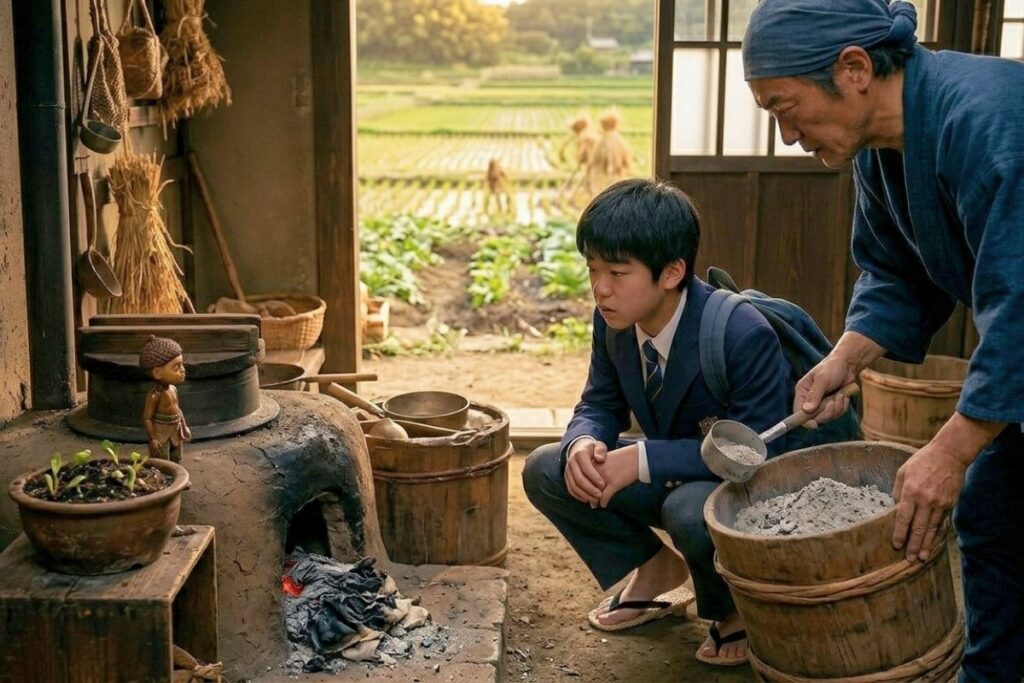
“Never. The blackened rag is burned in the hearth to become ash. And even that ash is bought by the ‘Ash Gatherer.’ Ash is used for dyeing cloth, making soap, and brewing sake. Finally, it is spread over fields as fertilizer to grow the crops for next year’s food. The life of the object moves in a perfect circle, revolving forever.”
4. 100% Plant-Based Wisdom
Ren noticed a pile of straw stacked in a corner.
“Is that just left over from the harvest?”
“That is Wara (rice straw),” Morinoko explained. “Edo farmers utilized 100% of it. 20% for daily goods, 50% for compost, and the rest for fuel.”
Ren saw people weaving the straw into sandals (zori), rain capes (mino), and sun hats. It was used to wrap fermented soybeans (natto), to thatch roofs, and to make the core of tatami mats.
“Even the light at night is a gift from plants,” Morinoko added. “The oil in the lanterns comes from rapeseed or cottonseeds. They lived by the rhythm of the sun—waking with the light and sleeping when it vanished. Even the residue left in the oil lamp became fertilizer. The word ‘waste’ simply had no place here.”
5. The Golden Link: City and Farm
“Ren, look at the river.”
Morinoko pointed to a boat loaded with large wooden vats heading upstream.
“Those are carrying ‘night soil’—human waste—from the city.”
Ren winced, but Morinoko continued seriously.
“While European cities of this era struggled with waste in the streets, leading to disease, Edo was the cleanest city in the world. Human waste was called ‘Gold’ and sold to farmers. It was the highest quality fertilizer, used to grow the fresh vegetables that would be sold back to the city. What the city consumed, the farm reclaimed. This massive ecosystem kept the circle unbroken.”
6. The Logic of Tsukumogami: The Soul in the Tool
“Ren, look at your Netsuke.”
Ren pulled the carved acorn from his pocket. It had fully become a miniature Morinoko.
“When a tool is loved and used for a long time, it gains a ‘heart.’ In Japan, we call these spirits Tsukumogami. Objects that reach their 99th year gain a soul. This is why the people of Edo didn’t recycle out of ‘duty’—they did it out of love. They chose beautiful second-hand clothes, patched them with personality, and lived in harmony with their possessions.”
Ren thought of his cracked mug back in his room.
“I wonder if I can bring it back to life, too.”
“The moment you thought that,” Morinoko whispered, “a new soul began to wake within it.”
The voices of Edo faded. Ren was back in his room in modern Tokyo. The city lights twinkled outside his window. Ren reached out and gently stroked the surface of his wobbly mug.
“Sorry,” he whispered. “Let’s stay together a little longer.”
That night, Ren didn’t look for a new mug online. Instead, he started searching for a way to fix the one he had. The “Circle of Life” the people of Edo showed him wasn’t a legend—it was a choice he could make right here, right now.
✍️ Epilogue: The Author’s Reflection — Memories of the “Circle”

As Ren finds his resolve, allow me to share a personal memory.
My mother was incredibly skilled at sewing. Even now, when I close my eyes, I can see her back as she sat at her sewing machine. It wasn’t the electric kind we have today; it was a vintage foot-pedal machine. She would tap out a rhythmic beat with her feet, and the needle would dance across the fabric.
She never threw away scraps of cloth (called hagire). She would combine them to create beautiful patchwork hangings or sew handmade bags and shoe pouches for my brother and me to take to school.
That “circle” extended beyond her sewing. Vegetable peels and food scraps from our kitchen went straight into the garden to become compost for our small vegetable patch. In the evening, she would often say to me, “Go pick some green onions for the miso soup.” What should have been “trash” returned to the earth and eventually back to our dinner table. That was the scenery of my childhood.
Growing up watching her, I found myself walking the same path.
I made my own children’s school bags from fabric scraps. When clothes got too small, I saved the fabric to make something else. I still have a habit of removing buttons and zippers from old garments to keep as materials for new creations. Even old furniture isn’t “garbage” to me; I take it apart, rebuild it, and give it a fresh coat of paint to serve a new purpose.
The habit of asking, “What else can this be?” before throwing it away is a gift my mother gave me—a deep affection for the “soul” of things.
To my surprise, this spirit has been passed down to my daughter as well.
She keeps her bags and wallets for years, long after I’ve asked, “Are you still using that?” In an age of fast fashion, I sometimes wonder if I should buy her something new, but then I feel a surge of joy knowing she has grown into someone who truly cherishes her belongings.
In old Japanese schools, you would often see a bar of soap hanging from the outdoor taps, tucked inside a small plastic mesh net (the kind used for oranges in the Showa era). It was a tiny, simple trick to make the soap last and stay clean—a small leftover of the Edo-style “no-waste” logic.

If you ever visit Japan and see a net of soap hanging by a tap, please remember this story. It is a quiet, humble remnant of our pride: the art of loving things until the very end.
🛠️ The Wisdom of the Forest: Learning Section
The lifestyle of the Edo period described in this story is based entirely on historical fact. Let’s look at the incredible systems that were centuries ahead of modern sustainability.
1. Edo’s 3Rs (Reduce, Reuse, Recycle)
Edo was a 3R paradise.
- Reduce: Alcohol, soy sauce, and oils were sold by volume. Customers brought their own containers, meaning no packaging waste was generated.
- Reuse: Specialized repairmen (for ceramics, pots, and lanterns) were common. It was socially and economically expected to fix things rather than replace them.
- Recycle: Everything—paper scraps, human hair, ash, old clothes, and even human waste—was bought by professional collectors to be turned into new resources.
2. “Wara” (Rice Straw): The Ultimate Multi-Material
Rice farming didn’t just produce food; it produced the foundation of life.
- Clothing: Rain capes (mino), sandals (zori), and hats.
- Food: Bales for rice, packaging for fermented beans (natto), and kitchen mats.
- Housing: Thatch for roofs, floor mats (tatami), and binding for mud walls. At the end of its life, straw goods were composted back into the soil. It was a 100% plant-based loop.
3. Bio-Energy and the Rhythm of the Sun
Night lighting was fueled by plant oils (rapeseed or sesame) or fish oil. Without fossil fuels, the people lived by a bio-mass energy cycle. Because oil was precious, the lifestyle was “Night = Sleep,” which naturally minimized energy consumption.
4. Urban-Rural Symbiosis: The “Gold” Trade
While London and Paris struggled with waste disposal and cholera, Edo was famously clean.
- 下肥 (Shimogoe): Human waste was traded as a commodity. It was sold to farmers to grow vegetables, which were then sold back to the city. This created a perfect nutrient cycle between urban consumers and rural producers.
5. The Logic of Tsukumogami
The belief that “objects gain a soul after 99 years” (Animism) acted as a social ethic. If you believe a tool has a heart, you cannot treat it violently. This spiritual logic was the backbone of Edo’s astonishingly efficient recycling society.
Foreshadowing for the Next Episode
The Netsuke in Ren’s pocket is beginning to remember its own origin—not just as a spirit, but as a “work” created by a master’s hand.
In Episode 4, we travel further back to the pinnacle of Japanese aesthetics: the core of the craftsman’s skill.
What does it take to breathe “life” into a tool?
Ren finds himself in a workshop of flying sparks, where a single sword is being forged from the soul of a master blacksmith.
「Read Episode 2 here」
「Read Episode 4 here」

About the Author
A native Japanese creator and passionate traveler born in Nagasaki and currently residing in the Kanto region. After studying in the U.S. during high school and working for a U.S. financial institution, she transitioned into the Japanese publishing industry, gaining a unique perspective on how to bridge cultures.
As a mother of two who has traveled extensively across Japan and to over 15 countries—from Egypt to Switzerland—she believes that understanding a nation’s underlying values is the key to global harmony. Through this site, she blends her love for storytelling and Japanese heritage to share the timeless morals and “Omotenashi” spirit with children and families worldwide.