[Introduction]
What would you do if you found a shiny coin glinting on the side of the road? In Japan, it is a common sight to see people taking even a small amount of money to a police box as a matter of course. Where does this “honesty” come from? Today, let us embark on a journey to the Japan of 1,300 years ago with Ren, a modern-day junior high school student, and Syl, a mysterious boy who appeared across time. By the time you finish reading this story, the existence of the “unseen eyes” that Japanese people have cherished for centuries will surely emerge in your own heart.
[The Story] Episode 1: The Weight of 500 Yen and Asuka’s “Unseen Eyes”

1. Modern Conflict: Rationality and the Restless Heart
It was twilight after school, and the Tokyo sky was dyed a burning orange. Ren, a seventh-grader, was standing by a vending machine in a corner of a residential neighborhood when he found a single coin reflecting the dull glint of the setting sun.
“…A 500-yen coin.”
As he picked it up with his fingertips, the heavy weight of the metal was transmitted to him. Until a year ago, Ren had lived in the United States due to his father’s work. Life there was rational, and the idea of “Finders keepers” was common among children. If it were a wallet, it would be different, but this was a single coin with no name and no way to identify the owner. Even if he took it to a police box, wouldn’t he just be troubling the officer?
“If I use this to buy that limited-edition ice cream I’ve always wanted, surely no one will be troubled.”
He told himself this. However, at that moment, an indefinable discomfort struck him—as if something cold had passed through the back of his throat, or a restless wave was stirring deep in his chest. It was then.
“That ice cream you buy with those 500 yen will surely have a very bitter taste.”
From the shadow of the bushes, a voice rang out—unbelievably small, yet dignified.
2. The Appearance of Syl: The Guardian of the Mark
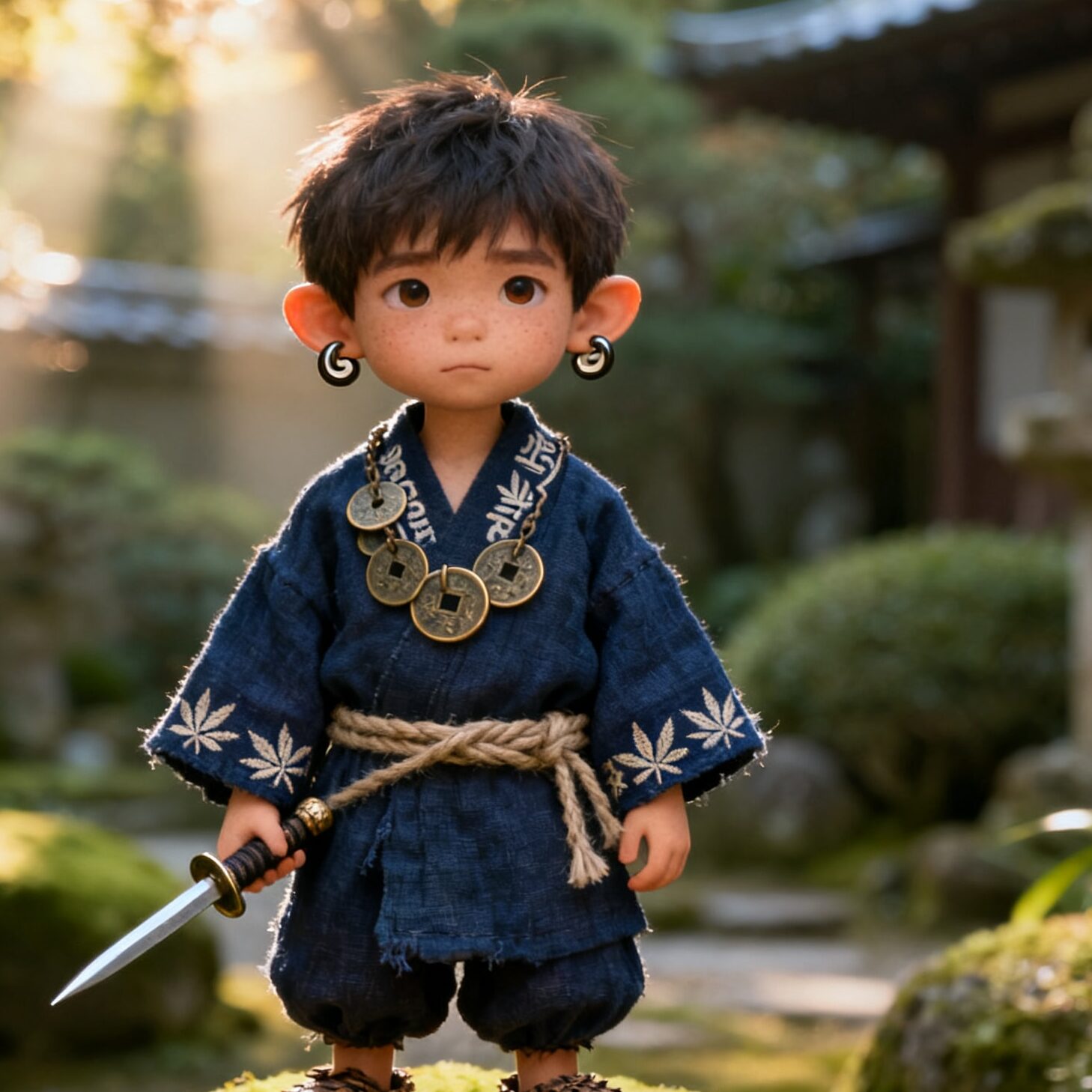
Startled, Ren looked down at his feet. There stood a boy with a mysterious appearance, about 15 centimeters tall. Though he had a refined face similar to a 13-year-old like Ren, his eyes held a deep wisdom that seemed to condense thousands of years of time.
Around his neck was a necklace shaped like an ancient copper coin. His indigo-dyed hemp clothing featured delicate “Asano-ha” (hemp leaf) patterns embroidered on the collar, which are said to possess the power to ward off evil. At his waist, he carried a sword as sharp as a needle but meticulously maintained, and on his feet, he wore boots made of real acorn skins that looked incredibly sturdy.
“…A dwarf? Who are you?”
“I am ‘Syl.’ I am the one who watches over and passes down the ‘Marks’ that have been engraved in the hearts of the Japanese people since before this nation was born. Ren, don’t you want to know the true identity of that ‘restless heart’ you feel now? Why Japanese people cannot betray themselves even in a place where no one is around? The answer lies in the era when the shape of this country was formed.”
Syl’s necklace emitted a pale blue light. The next moment, the motor sound of the vending machine vanished, and Ren’s vision was instantly overwritten by a primeval forest and the scent of damp earth.
3. The Asuka Period: Emperor Tenji’s Reforms and the Birth of “O-Tento-Sama”
The two arrived around the year 670 AD. It was a highway near the Omi-Otsu Palace in what is now Nara Prefecture.
“This is the Asuka period. It is a turbulent time of transformation when Emperor Tenji created Japan’s first national census, the ‘Kogo-nenjaku,’ and people began to realize for the first time that they were not just a ‘clan,’ but ‘citizens of the nation of Japan.'”
By the side of the road, farmers clad in crude cloth were sweating as they carried heavy sacks of rice. On a large rock by the wayside, hand-woven baskets were placed, filled with freshly picked wild chocolate vines, small persimmons, and chestnuts from the mountains. However, there was not a single guard around.
“Syl, look. If you leave food in a place like that, someone will steal it,” Ren said worriedly. Syl shook his head quietly.
“Watch. Two forces are working on those farmers now. One is the newly introduced ‘Ritsuryo’—the law. This is an external rule stating that if you steal, you will be severely punished. But the other is deeper. In this era, Japan’s indigenous ‘Shinto’ merged with the teachings of ‘Buddhist’ cause and effect (Karma) brought from the continent.”
Just then, a boy passed by. He seemed hungry and his eyes were drawn to the fruit, but he immediately straightened his posture, bowed deeply toward the sky, and walked on.
“Who was he bowing to?”
“To no one in particular. Japanese people believe that gods (Kami) reside in all things. The stones by the road, the sun in the sky, and even one’s own conscience—everything is an ‘eye that sees you.’ They called this ‘O-Tento-Sama.’ There is no place in this world where no eyes are watching. If you betray yourself, you disrupt the harmony of the universe and stain your own ‘virtue.’ That is the greatest shame for them.”

At that moment, an elderly woman on the road dropped a piece of “cloth” (the currency of the time) that she had been holding dearly. The man walking behind her picked it up without hesitation, caught up with her, and handed it over with a smile. To the woman who thanked him, the man did not boast of himself; he simply gave a nod as if it were the natural thing to do and departed.
4. Return to the Present: The Pride of Not Betraying Oneself
A wind blew through, and when Ren opened his eyes, he was back in the twilight park. The 500-yen coin was still gripped in his palm. He had been holding it so tightly and dearly that it left an impression of his fingers.
“Syl, I understand now. It wasn’t that I wanted ice cream; I wanted to be a version of myself I could be proud of, one who doesn’t lie to himself.”
He looked around, but Syl was no longer there. Only the sun, sinking into the western sky, illuminated Ren’s shoulders gently, as if it had witnessed everything. Without hesitation, Ren began walking toward the police box at the park’s exit. The 500-yen coin felt like more than just money; it felt like a “baton of integrity” that had been connected through 2,700 years of history.
[Epilogue] The Baton Passed from Parent to Child
When he opened the door of the police box, a police officer with a calm expression was sitting there. “Officer, I found this. I don’t know who the owner is… but I’m turning it in.” The hand Ren held out with the 500-yen coin was no longer trembling. The officer said, “Thank you. This money you brought is great proof that you did the right thing,” and carefully recorded Ren’s name in the ledger. Neither an address nor a phone number was necessary. The words “Thank you” were more than enough.
Actually, I have an unforgettable memory of my own. When my child was in elementary school, they found a 100-yen coin on the way home from school and went to the police box alone to turn it in. To my child, who was too small to even communicate contact information properly, the officer simply said, “Thank you for bringing it.” I do not know what happened to that 100 yen afterward. However, on that day, a pride that will never disappear was engraved in my child’s heart: the pride of “not betraying oneself.” This education, passed from parent to child not through logic but through “action,” is the invisible force that supports the safety and integrity of Japan.
[Historical Treasure Box] The Behavioral Principles of the Japanese Since the Asuka Period
(This section transforms the lingering feelings of the story into knowledge.)
1. Emperor Tenji’s Reforms and the Birth of “Japan” as a Consciousness
In the latter half of the 7th century, the setting of this story, Japan was in a major period of transition as a nation. Until then, people lived within the small framework of “clans” (families or regions), but in 670 AD, Emperor Tenji created Japan’s first national census, the “Kogo-nenjaku.” This was not merely a population survey. By having each individual’s name recorded by the state, people began to have a sense of “public” (Ooyake)—the awareness that “I am a member of the nation of Japan”—for the first time. This sense of “being a part of society” became the foundation for the public spirit of not personalizing items found in public spaces.
2. The Dual Structure of “Ritsuryo” (Law) and “Toku” (Ethics)
At that time, Japan introduced the “Ritsuryo,” a sophisticated legal system from China (Tang Dynasty). However, Japanese people did not become honest solely through “external force” like the law (not doing something because they would be caught). During the same period, the Buddhist teaching of “Inga-oho” (the law of cause and effect: good deeds return to you, and bad deeds also return to you) spread and merged with the ancient belief in the Yaoyorozu no Kami (eight million gods). This is the unique Japanese view of ethics: “O-Tento-Sama (the sun / the order of the universe) is watching.” Even in places where the eyes of the law do not reach, one cannot deceive the eyes of the gods and Buddhas within one’s own “conscience.” This “introspective integrity” is the behavioral principle of the Japanese people that carries a 500-yen coin of unknown ownership to a police box.
3. The Culture of “Wa” (Harmony) and “Haji” (Shame)
Another reason why Japanese people are honest lies in the culture that extremely dislikes disrupting “Wa” (harmony). In a community, silently taking someone’s lost property for oneself is an act that destroys the invisible relationship of trust—the “Wa.” If this were to be revealed, it would be an unbearable “Haji” (shame) not only for oneself but also for one’s family and ancestors. This “culture of shame” is by no means negative. It is a very sophisticated system of autonomy: “protecting the peace of society as a whole by disciplining oneself and respecting others.”
4. The Spirit Inherited by the Modern “Koban” (Police Box)
The “Koban” system, spread like a net across modern Japan, attracts attention from all over the world. However, the Koban functions not only because the police officers are excellent, but because the citizens believe that “returning found money to the police is a natural pride as a human being.” According to statistics, the amount of cash turned in to the police as lost property in Japan reaches tens of billions of yen annually. Much of it consists of small change and bills with no names or any certainty that the owner will come forward. The “honesty watched over by O-Tento-Sama” that sprouted 2,700 years ago in the Asuka period continues to support a safe society unparalleled in the world through the small police boxes on Japan’s street corners today.
[Author’s Perspective] Passing the Baton of the Unseen Eyes to the Future
With the development of the Internet and SNS, modern society has become highly anonymous—”no one knows who wrote it” or “no one knows who did it.” However, precisely because we live in such an era, the Japanese spirituality of being conscious of the “unseen eyes” (one’s own conscience), which has continued since the Asuka period, may serve as a great hint for people around the world to live together in harmony and mutual respect.
“O-Tento-Sama is watching.”
With these words in our hearts, what kind of baton can we pass on to the next generation? I hope that through this article, you have felt the deep cultural layers of Japan.
「Read Episode 2 here」

About the Author
A native Japanese creator and passionate traveler born in Nagasaki and currently residing in the Kanto region. After studying in the U.S. during high school and working for a U.S. financial institution, she transitioned into the Japanese publishing industry, gaining a unique perspective on how to bridge cultures.
As a mother of two who has traveled extensively across Japan and to over 15 countries—from Egypt to Switzerland—she believes that understanding a nation’s underlying values is the key to global harmony. Through this site, she blends her love for storytelling and Japanese heritage to share the timeless morals and “Omotenashi” spirit with children and families worldwide.