Introduction
In our modern world, we live surrounded by convenience. With a single click, something new arrives; when it breaks, we discard it without a second thought. But in ancient Japan, the creation of a single tool was considered a sacred “prayer.” It was believed that at the moment of completion, a soul was breathed into the object.
In Episode 3, Ren experienced the “Circle of Life” in Edo, where objects were treated not as mere commodities, but as spiritual partners. This time, we go even deeper: How is “life” actually forged into a physical object?
We shall travel with Ren to the forge of a master swordsmith—the pinnacle of Japanese aesthetics and spirituality. In an age of mass production, we invite you to rediscover the passion of a craftsman who pours his entire soul into his work. Get ready to witness the awakening of the soul within the steel, touching the very core of the Japanese spirit that has endured for 2,700 years.
[The Story]
1. The Masterpiece in the Workshop
A few days had passed since visiting Suitengu, and Ren was back in his ordinary world. Yet, he couldn’t stop thinking about the acorn. He felt that small seed held the key to a grand destiny.
After school one day, on a whim, Ren visited an old woodworking workshop on the edge of town. It was a place where time stood still, run by a craftsman his grandfather had once known well.
Deep in the workshop, amidst well-used planes and chisels, Ren sat in silence. The scent of sawdust and the golden twilight created a peaceful atmosphere. He stared at a figure on the workbench. It wasn’t the acorn anymore.
“Is it… you?”
Responding to his voice, the figure moved. A tiny boy, only 15 centimeters tall, stood there. His skin had the deep, polished luster of ancient timber—a rich patina like a masterpiece carved by a master hand. He wore a small cap made of an acorn shell.
“Hello, Ren. We meet again.”
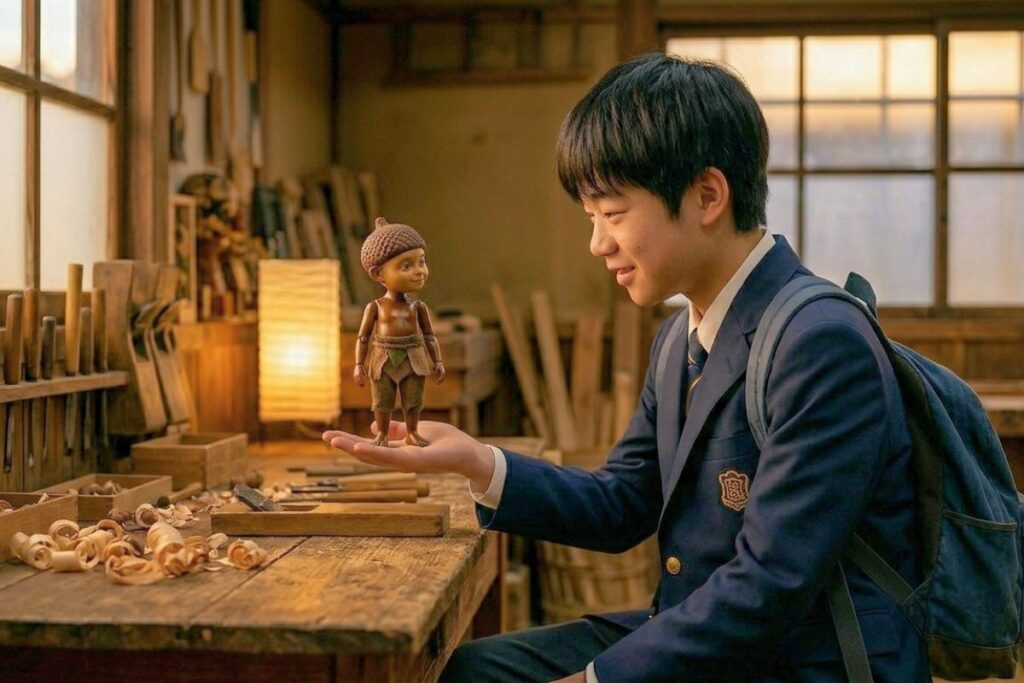
As the little person spoke, his wooden texture softened into that of a living being. With a cute, warm smile, he introduced himself as Morinoko.
“Objects have two lives, Ren. One is the physical form. The other is the soul that awakens when a human pours their heart into it. Today, let’s go witness the moment a soul is born.”
2. The Sparks of the Forge: The Swordsmith’s Soul
Morinoko snapped his fingers, and the workshop blurred. The scent of sawdust vanished, replaced by the choking smell of charcoal and a searing heat.
“Whoa!”
Ren opened his eyes to a dimly lit earthen forge. Sacred straw ropes hung from the walls, signaling a holy space. In the center was a glowing fire, where a man silently hammered steel.
“Ren, look at your feet,” Morinoko giggled.
Ren looked down. Beneath his navy school uniform, his sneakers had turned into zori—traditional straw sandals. “What? Is this magic?”
“If you walked around in modern sneakers, people here would lose their minds. We can pass off your uniform as ‘strange foreign clothes,’ but those shoes were a bit too much.”
“I see… actually, these sandals are surprisingly comfortable.”
As they looked up, the master swordsmith swung a heavy hammer.
Clang!
A high-pitched metallic ring echoed, and golden sparks erupted from the red-hot steel. These weren’t ordinary sparks. In the dark forge, they danced with complex, living trajectories before fading away.
“Look, Ren. In every single strike, the master pours his entire life.”
3. The Hammer of Life: Awakening the Tsukumogami
Ren watched, breathless. Every time the hammer fell, he saw “golden ripples” spreading through the steel. It wasn’t a physical vibration, but something deeper—a tremor of the soul.
“Japanese craftsmen have always seen creation as a ‘sacred ritual,'” Morinoko said, hopping onto the master’s shoulder with a serious expression. “To turn a mere lump of iron into a blade that protects someone… you must shave off pieces of your own soul and transfer them into the metal.”
Sweat poured from the master’s brow, his eyes showing no hesitation. With every strike, the air in the forge grew tighter, sharper.
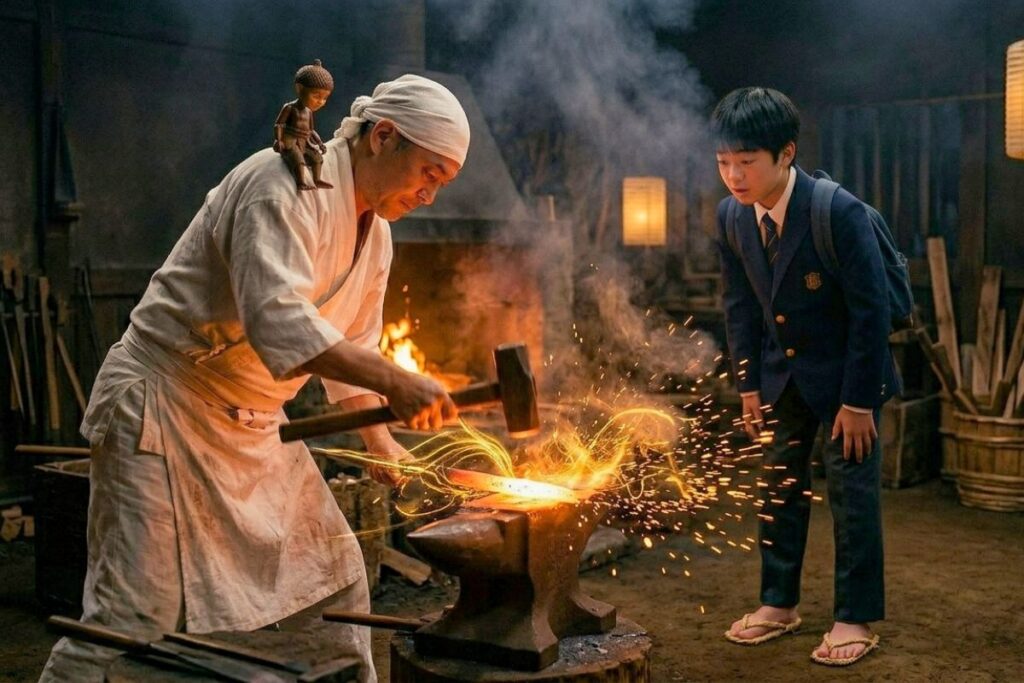
“This is repeated thousands, tens of thousands of times. An object forged to its absolute limit eventually gains a will of its own. That is the origin of the Tsukumogami. The name means ’99-year-old spirit,’ one year short of a hundred. It represents the ‘eternal effort toward perfection.'”
Listening to those words, Ren remembered his own scratched mug back in his room. Could his affection for that object be connected to this master’s passion?
4. The Awakening of the Blade’s Soul
Finally, the moment arrived. The master raised the forged blade high.
“It is done…”
He whispered, and a brilliant golden light erupted from the edge of the sword. It was warmer than sunlight, a quiet, profound radiance. Ren instinctively reached out. On his palm sat Morinoko, now back in his polished wooden form.
The light enveloped them, and the “memories” stored within the steel began to flow into Ren. He felt the memories of the iron when it was still sand in the mountains, the memory of being scorched by fire, tempered by water, and the memory of receiving the craftsman’s prayers.
“Look, Ren. The blade is breathing.”
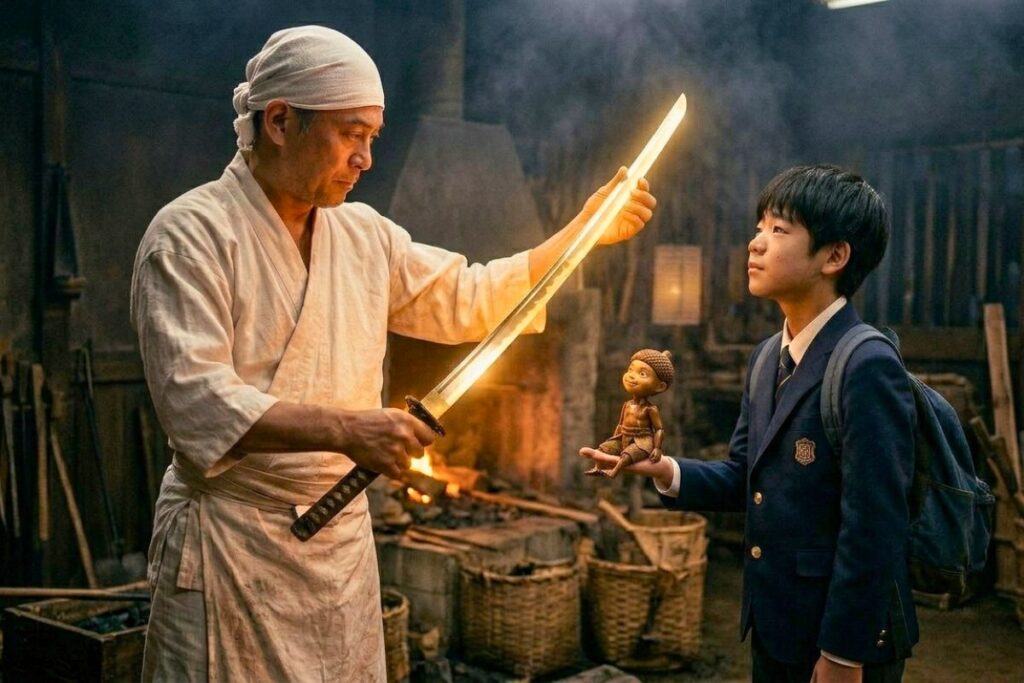
Indeed, the sword flickered faintly, beating with the strength of a newborn. An object created with such soul is no longer a mere “tool.” It becomes “family,” living alongside its owner.
“To cherish an object means to value the hearts of everyone who touched it, doesn’t it?”
As Ren whispered this, the light intensified, filling the entire forge with a golden glow.
5. The Return of the Soul: The Answer Ren Found
As the dazzling golden light of the sword swallowed the entire forge, Ren squeezed his eyes shut against the brilliance. In that heartbeat, the pungent scent of charcoal and the searing heat that had baked his skin vanished like a receding tide.
In their place, the faint fragrance of sawdust and a gentle evening breeze brushed against his cheeks.
When Ren opened his eyes, he was back in the quiet woodworking workshop on the edge of town. He looked down at his feet. As if the magic had unraveled, his familiar navy-blue sneakers had returned. Yet, the warmth of the earthen floor he had pressed with his straw sandals still lingered on the soles of his feet.
On his palm, Morinoko—who had been so vibrantly alive just moments ago—had returned to the form of a silent, polished “wooden carving.” But Ren knew better. Deep within this tiny figure, the same fierce and powerful pulse of a soul he had witnessed in the blade was still beating.
“…There’s no such thing as ‘just an object,’ is there?”
Ren whispered to himself, looking at the frayed straps of his backpack and the old tools resting on the workbench. He felt that every one of them was a continuation of a “story of life”—crafted with someone’s soul and cherished by someone’s hand.
By the time Ren stepped out of the workshop, the sky had deepened into a rich ultramarine. Inside his backpack, he felt as though the little Morinoko gave a faint, satisfied smile.
✍️ Epilogue: A Story of the Souls Beside You

As I write this, I have an old pen on my desk. I received it from someone dear to me years ago. The surface is worn, but whenever I hold it, I feel a strange sense of calm.
In Japan, there are traditions like Hari-kuyo (Festival of Broken Needles) or Fude-kuyo (Memorial Service for Brushes). Before letting go of a tool that has served its purpose, we say “Thank you for your hard work.” This is a rare and beautiful custom.
My daughter, too, brings me her favorite stuffed animal when a thread comes loose, saying, “Fix it so it doesn’t hurt.” Perhaps children naturally see the souls within objects.
In today’s fast-paced world, the idea that “if it’s broken, buy a new one” is dominant. But using something crafted with soul, repairing it, and loving it over time… that affection is what truly enriches our lives.
I am sure there are objects with souls all around you. Next time you use them, try talking to them in your heart. They will surely respond to you.
🛠️ Learning Section: For Adults
1. The Soul-Infused Strike: The Hammer of the Swordsmith
The creation of a Japanese sword is far more than mere metalworking. A craftsman approaches the forge in a spiritual state of “purifying the body and inviting the gods.” Each strike of the hammer is an act that goes beyond shaping the iron; it is the process of carving the craftsman’s very spirit into the steel. This “transference of the soul” is precisely one of the reasons why Japanese swords are revered as “works of art” across the world.
2. The Philosophy of Tsukumogami: The Spirit of Ninety-Nine
The number “Tsukumo” (ninety-nine) represents a value that is one short of a hundred (perfection). This embodies a fusion of two ideas: the humility that “because one is not yet perfect, one must continue to strive eternally,” and animism—the belief that objects acquire a spiritual nature after many long years (ninety-nine years). Since ancient times, the Japanese people have found divinity not only in the natural world but also within man-made objects.
3. Craftsmanship and the Bond of the Circle
The “Circle” we explored in Episode 3 is sustained by the skills of the craftsman. Because there are people capable of repairing them, objects do not “die.” Furthermore, it is precisely because an object is imbued with a soul that people feel the desire to say, “I want to keep using this, even if it requires repair.” This blissful relationship between “skill” and “attachment” is the true essence of the sustainability that has endured in Japan for 2,700 years.
👉 Foreshadowing the Next Episode
Ren has learned of the “soul created to protect” that dwells within a katana. However, Morinoko says: “Fire is not the only thing that breathes life into objects. Next, let’s go see the ultimate wisdom of Japanese healing, woven together by ‘Water’ and ‘Earth’.” …The gears of a new time-travel journey begin to turn. Please look forward to the next story, Episode 5.
「Read Episode 3 here:How Did Edo Become the Ultimate Zero-Waste City? The Wisdom of the Circulating Soul」
「Read Episode 5 here:Why is Bathing a Sacred Ritual in Japan? Rejuvenating the Body Through the “Toji” Circle」
About the Author
A native Japanese creator and passionate traveler born in Nagasaki and currently residing in the Kanto region. After studying in the U.S. during high school and working for a U.S. financial institution, she transitioned into the Japanese publishing industry, gaining a unique perspective on how to bridge cultures.
As a mother of two who has traveled extensively across Japan and to over 15 countries—from Egypt to Switzerland—she believes that understanding a nation’s underlying values is the key to global harmony. Through this site, she blends her love for storytelling and Japanese heritage to share the timeless morals and Japanese spirit with children and families worldwide.