[Introduction: Why Are We Drawn to the Sound of Festivals?]
Have you ever felt your heart skip a beat at the distant rumble of a Taiko drum? Have you ever felt a strange sense of nostalgia in the soulful melody of a Japanese flute?
In our modern lives, we are drowning in “words.” We communicate via social media and email, yet words often feel like clumsy tools, unable to convey our deepest emotions. When the Japanese people of old felt overwhelming joy or gratitude toward the universe, they set aside words and entrusted their souls to rhythm and dance. This is the origin of “Matsuri” (festivals).
At the heart of this is “Yaoyorozu no Kami”—the belief that divinity resides in all things. For the Japanese, gods were not distant figures; they were beings to laugh, dance, and celebrate with. This philosophy, “Shinjin Kyoraku” (Gods and Humans Rejoicing Together), is the true essence of Japanese communication.
In this journey, Ren struggles with the walls of language, unable to express his true feelings to a friend. Guided by the spirit of sound, he travels to the roots of Japanese performance. Why do we beat the drum? Why do we dance in silence? The answer lies not in logic, but in the sacred resonance that awakens the soul.
[The Story]
1. The Wall of Words
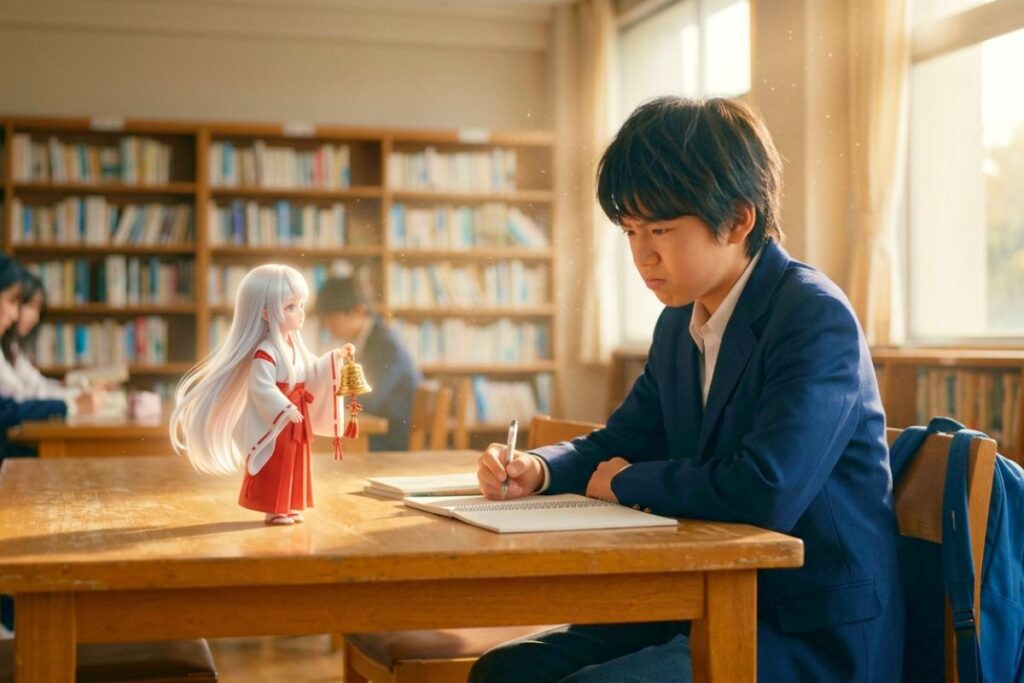
It was lunch break at school. Ren sat in the corner of the library, his heart heavy after a small argument with his best friend. “I explained it so clearly, but he didn’t get it at all. The more I talk, the more misunderstood I feel…”
The difficulty of conveying one’s heart accurately and without hurting others—Ren sighed, hugging his blue backpack.
“Ren, you look troubled. If words are failing you, let me show you a way to connect at a much deeper level. In your current state, you may require the guidance of this one.”
Morinoko gave a heavy, solemn nod and reached deep into the shadows of the backpack as if signaling to someone within. Then, another tiny figure floated gently into view beside him.
She stood only fifteen centimeters tall—a lovely girl dressed in robes of purest white, holding a small golden bell. Her hair was as pale and smooth as silk, and with every graceful movement, a crystalline “chime” echoed through the air.
“I am Suzune, a spirit of sound and dance. …Master Morinoko, did you call for me?”
“Indeed,” Morinoko replied. “Teach this boy the power of ‘resonance’—the kind that transcends all logic.”
At his word, Suzune turned to Ren and offered a deep, elegant bow. “Ren, shall we break through the shell of words and travel to a place where hearts truly resonate?”
As Suzune gave the golden bell a grand sweep, the very air of the library began to vibrate with a powerful, rhythmic hum.
2. The Night of Myth: The First Festival
Ren found himself standing in a pitch-black forest. Looking down, his modern sneakers had vanished, replaced by roughly woven “Waraji” (straw sandals). He was still in his school uniform, but the cold earth and the texture of the straw told him he was no longer in the present.
“Where are we?” “This is the site of the very first ‘Matsuri’ in Japan. In front of the Ame-no-Iwato (The Heavenly Rock Cave).”
Looking up, a massive rock door stood shut, sealing off a mountain. The sun goddess, Amaterasu, had hidden inside, plunging the world into total darkness. The other gods were gathered around, a heavy, despairing silence hanging over them.
Suddenly, a goddess named Ame-no-Uzume overturned a large wooden barrel and began to stamp on it powerfully. “Thump, thump, thump!” To the rhythm, she began to dance wildly, without inhibition. Seeing her comical yet powerful movements, the other gods broke into a sudden roar of laughter.
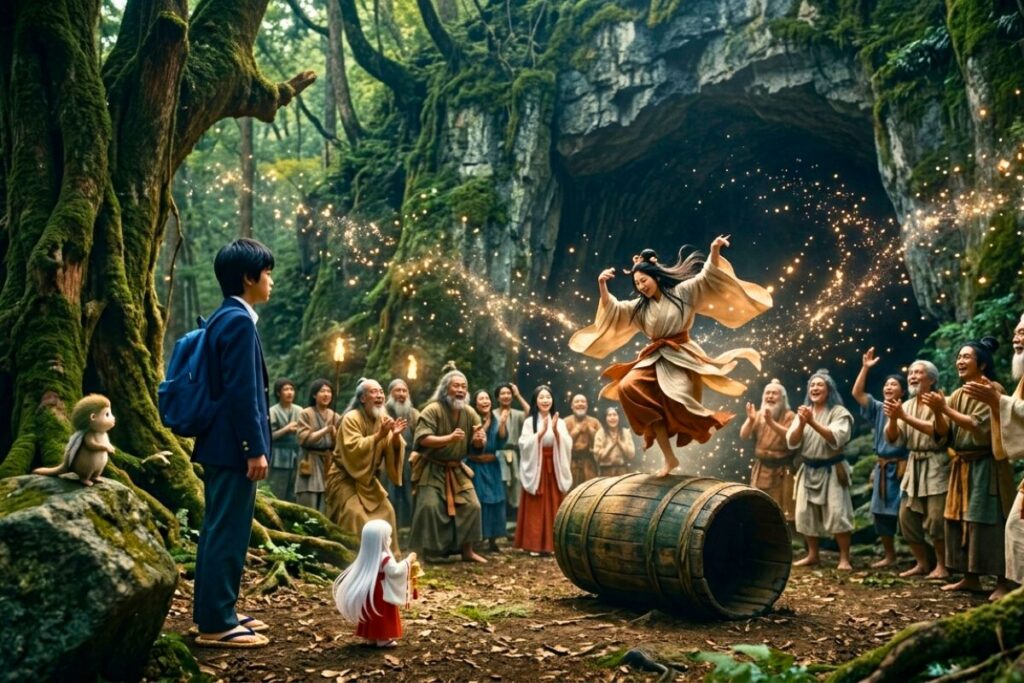
“Hahaha! Look at her!””More! Do more!” The darkness, once filled with silence and despair, began to shake with the vibration of the gods’ laughter and the rhythmic stomping of feet.
Ren watched in awe. “She’s not trying to persuade her with words… she’s dancing, making them laugh, and brightening the atmosphere.” Behind the rock, Amaterasu thought, “It should be dark out there, so why do they all sound so happy?”
The moment she opened the rock just a crack to peek out, light returned to the world. “This is the beginning of Japanese performing arts,” Suzune whispered. “It’s not grand logic that brightens a dark heart, but the resonance of the soul.”
3. The Medieval Village: Prayer in the Mud
Next, they appeared in a medieval farming village (Kamakura period), where golden stalks of rice bowed their heads. Ren’s feet had changed from straw sandals to mud-stained “Tabi” socks.
The villagers were forming a circle on the narrow paths between the rice paddies. One played a flute, another beat a large drum (tsuzumi). In sync, the villagers jumped high and stamped firmly on the ground. “Ya! Ya! Bring us a harvest!”
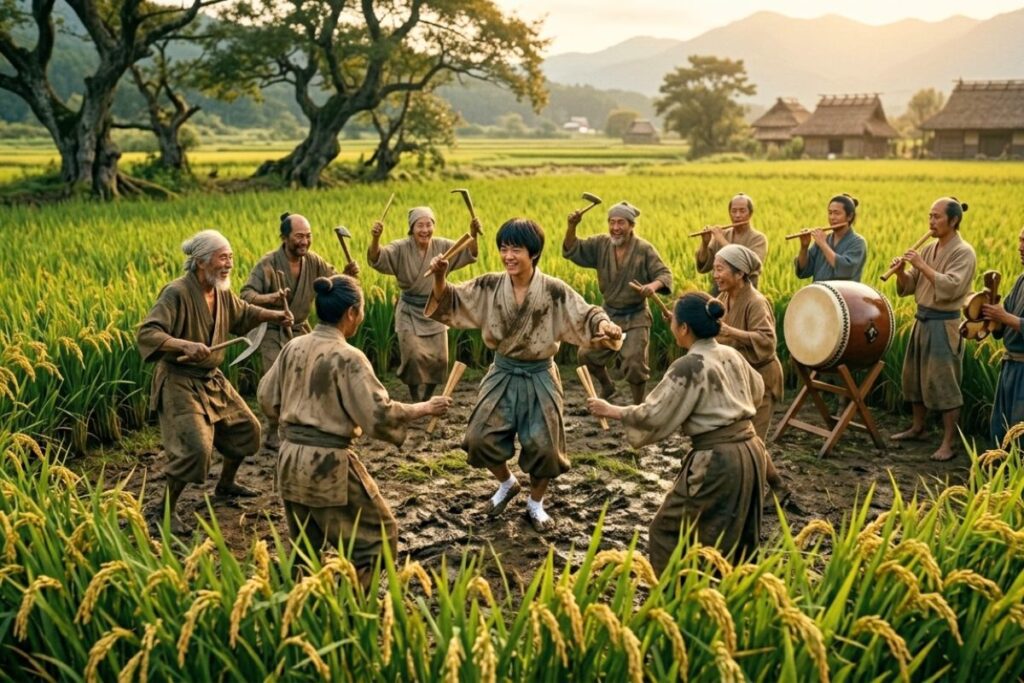
This was “Dengaku,” a dance to pray for a bountiful crop. “Ren, look. They aren’t reporting to the gods with words. They are using their entire bodies to awaken the energy of the earth.”
Ren was drawn into the circle. At first, he felt shy, but as the vibration of the drum traveled from his soles to his heart, a strange sense of exhilaration bubbled up. “I don’t need words. Just by jumping together and keeping the same rhythm, I feel like I understand how that old man next to me feels!”
Covered in sweat and mud, Ren felt the “oneness”—a communication beyond words—through his very skin.
4. The Roar of Edo: Exploding Energy
Finally, Suzune took him to a vibrant night festival at a shrine in the Edo period. Ren’s footwear had changed again, this time to stylish “Setta” sandals.
The air was thick with the scent of street food and the glow of hundreds of lanterns. A massive festival float (Dashi) was being pulled through the crowd. “Wasshoi! Wasshoi!” The shouting was like a tremor in the ground. The piercing flute sliced through the air, and the great O-daiko drum shook Ren to his core.
On a wooden stage, a performer in a terrifying mask danced fiercely. This was “Kagura,” recreating the stories of the myths. “Suzune, is the god inside that person?” “Yes. But the god is also inside the people watching. In the sound and fever of the festival, Japanese people ‘shake’ their souls to be born anew. We call this ‘Tama-furi’ (soul-shaking).”
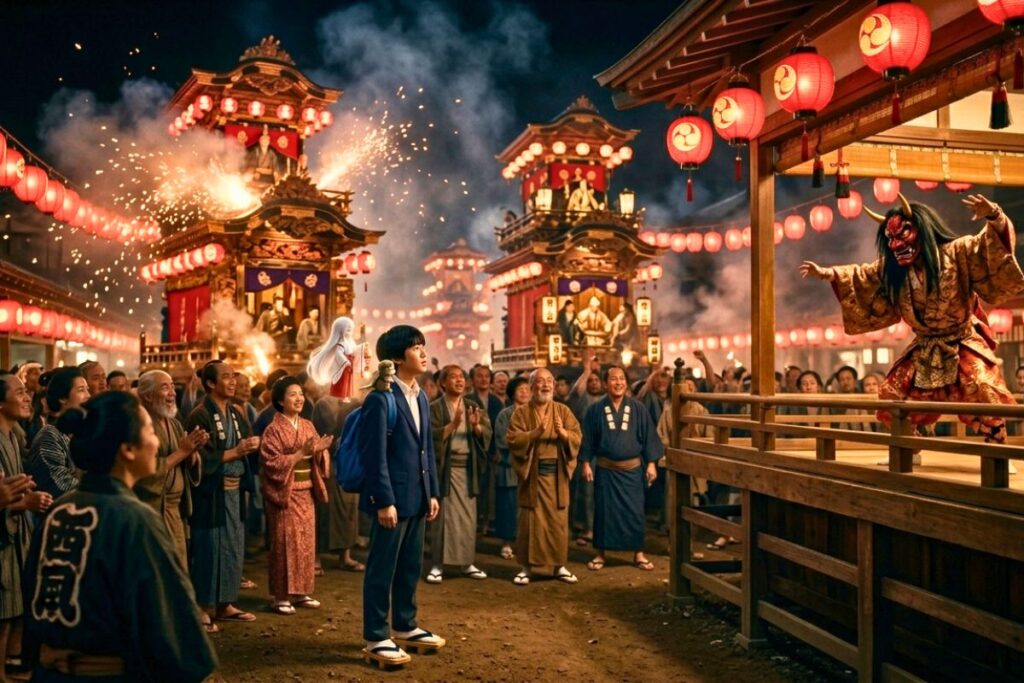
Ren let himself go into the vortex of sound. The small worries he held—his frustration with his friend, his petty ego—were swallowed by the massive energy of the festival and purified.
“What I wanted to tell my friend wasn’t a list of reasons. I just wanted to laugh together. I just wanted to share the same rhythm.”
5. Ren’s Realization: The Resonance of the Heart
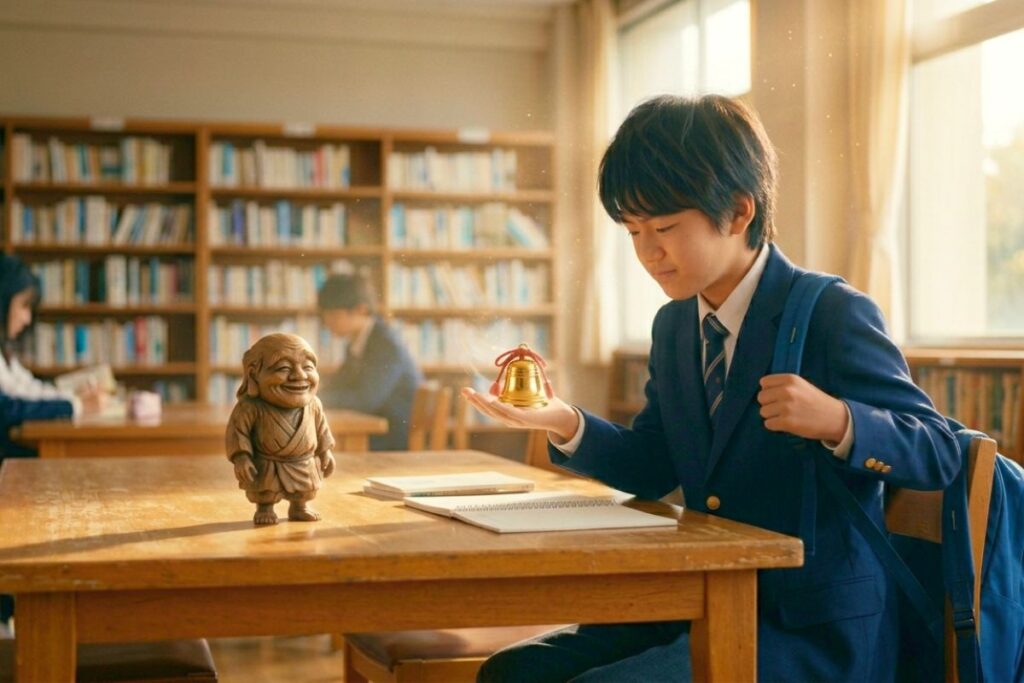
When they returned to the library, the faint echo of the drums still vibrated in Ren’s ears. In his palm, Morinoko and Suzune remained. Suzune quietly closed her eyes and transformed back into a small golden bell. A faint, sweet scent of incense lingered in the air for a moment.
“Ren, how was it?” Morinoko asked. Ren, with a much clearer expression, adjusted his blue backpack. “Words are important, but I realized the ‘resonance’ that comes before them is even more vital. You have to listen to the other person’s sound and match your own to it. Like a festival.”
Ren gazed intensely at the wooden Morinoko resting in his palm, then suddenly caught his breath.
“…Morinoko, has your face changed? When we first met, you looked like a thirteen-year-old boy, just like me. But now… you look like a wise elder who has known the secrets of a thousand years.” Then, Morinoko—now in the form of a sacred Okina (a wise, smiling elder mask common in ancient theater)—answered in a voice…
“Ren, forgive me for startling you. As you deepen your understanding of the teachings of O-tento-sama and witness the true beauty of this world, my form returns to its ‘true self’—a vessel carved by the wisdom of the ages.”
Ren gently stroked the wooden carving, which seemed to have gained a subtle, sacred weight.
“From this point on,” Morinoko continued, “I shall not be your only guide. I will act as a wellspring of wisdom, summoning specialist guides from among the Yaoyorozu—the eight million gods—from within your backpack. It is proof that you are ready to step into a much deeper world. Next… yes, I think it is time to call upon an old friend of mine.”
Ren walked out of the library toward the friend he had argued with. This time, before lining up “I’m sorry” in words, he would look him in the eye, take a breath, and give him a smile and a pat on the shoulder. That was the “new language” taught to him by 2700 years of history.
✍️ Author’s Epilogue: Feeling the “Heartbeat of the Earth”

I love the unique “temperature” of Japanese festivals. It’s not a polished, sterile form of entertainment; it’s something raw, earthy, and powerful.
In my previous story, I mentioned how my daughter insisted on walking barefoot. Interestingly, many of Japan’s traditional performing arts—Noh, Kabuki, Kagura—are based on a movement called “Ashi-byoshi” (foot rhythm), where the performer stamps firmly upon the earth, making the stage itself ring, the performer doesn’t just “walk” on the stage; they “stamp” on it.
This act is meant to awaken the spirits sleeping in the earth. When my daughter walked barefoot on the asphalt and said it was “fun,” perhaps her soul was unconsciously receiving a message—a vibration—from the earth itself.
Adults often try to understand the world through logic and words. But on the night of a festival, when the drums roar and the people lose themselves in the rhythm, we all return to being “children” who didn’t yet know words. We stop overthinking and surrender to the “Ki” (energy) and rhythm of the moment, connecting with those around us and the unseen gods.
Japanese culture places great value on “Ma”—the space or silence between sounds. It is a time to feel the other person’s breath and align your own. In our fast-paced modern world, this “Ma” is often forgotten, but I believe it is the secret to “Sassuru”—the silent, deep-rooted empathy that builds truly rich relationships.
If you ever have the chance to visit Japan, please go to a festival. Put aside your words and simply feel the sound vibrating through your body. I guarantee the “Yaoyorozu no Kami” within you will wake up and start to dance.
👉 Learning Section for Adults
1. The Spirit of “Shinjin Kyoraku” (Gods and Humans Enjoying Together)
Unlike Western concepts of a transcendent, absolute deity, Japanese gods are seen as close, familiar beings who share our daily lives. Festivals are not just about comforting the gods; they are about enjoying life with them. This shared joy is believed to restore the power of the gods and renew the life force of the people—a process called Tama-furi.
2. “Ashi-byoshi” and Grounding
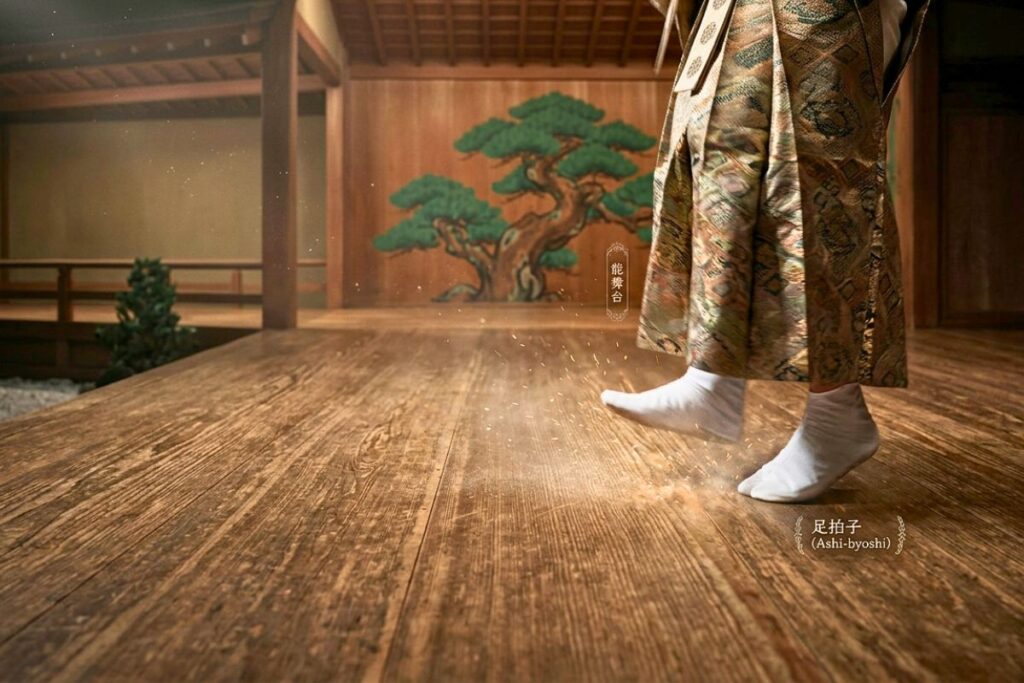
In Japanese dance, the “shosa” (gesture) of stamping on the ground is more important than lifting the feet high. This reflects the memory of an agrarian people who prioritized their connection to the land. Through these arts, people were essentially performing what we now call “Earthing” or “Grounding,” maintaining a spiritual and physical link to the planet’s energy.
3. Japanese Acoustics: Resonance and “Sawari”
Traditional Japanese instruments (like the Shamisen, Biwa, or Flute) are often designed to include “noise” or “buzzing” called Sawari. This is a deliberate technique to create sounds that mimic nature—the rustle of wind or the chirp of insects. The Japanese aesthetic finds beauty in these “fluctuations” that harmonize with the natural world, rather than pursuing a mathematically “pure” tone.
🔮 Foreshadowing: To the Next Journey…
Ren had learned the magic of resonance—the soul-stirring harmony of sound and dance—from Suzune. Yet, the Japanese spirit is not defined by festive fervor alone.
Morinoko reached once more toward the back of the shelf, his movements now deliberate and reverent, as he withdrew a sheet of ancient, weathered Washi paper.
“To silence the sound, to still the body, and to gaze into a single point of absolute tranquility,” Morinoko whispered. “Next, we shall journey into the realm of ultimate minimalism—the world of Do (The Way). A dear friend of mine awaits you there—a samurai more disciplined and steadfast than any you have ever known.”
Episode 8: Bushido. Alongside the tiny warrior Ichinoshin, discover the spiritual heights that dwell within the Kata—the perfection of form.
「Read Episode 6 here:The Universe in a Single Bowl — The Spirit of “Omotenashi” Forged by Earth and Fire」
「Read Episode 8 here」
About the Author
A native Japanese creator and passionate traveler born in Nagasaki and currently residing in the Kanto region. After studying in the U.S. during high school and working for a U.S. financial institution, she transitioned into the Japanese publishing industry, gaining a unique perspective on how to bridge cultures.
As a mother of two who has traveled extensively across Japan and to over 15 countries—from Egypt to Switzerland—she believes that understanding a nation’s underlying values is the key to global harmony. Through this site, she blends her love for storytelling and Japanese heritage to share the timeless morals and Japanese spirit with children and families worldwide.