[Introduction: Have You Ever Heard the “Voice” of a Bowl?]
Think about the bowls and cups you use every day. In our modern lives, we often treat them as nothing more than disposable tools. If they break, we replace them. Surrounded by uniform, factory-made perfection, we have forgotten the “Story of the Earth” from which these tools were born and the human prayers infused within them.
In Japan, there is a unique aesthetic that finds beauty in a warped bowl or in the “Kintsugi” (golden joinery) that celebrates mended cracks. This is “Wabi-sabi”—a perspective that finds the vastness of the universe within things that are imperfect, transient, and humble.
This philosophy is the true foundation of “Omotenashi.” It is not just about service; it is the invisible art of preparing a space—sweeping the path, choosing the perfect vessel, and thinking deeply of a guest long before they arrive.
In this journey, 13-year-old Ren witnesses the moment when the “Power of the Earth” takes on a soul through human hands and fire. What will he find in a tiny 16th-century tea room, after having pursued only visible perfection? Join us as we peer into the infinite universe contained within a single bowl of tea.
[The Story]: The Universe in a Bowl
1. The Frustration of Seeking Perfection
Since returning from their hot spring trip, the air in Ren’s family home had become noticeably softer. However, Ren, a seventh-grader, still struggled with his own internal pressures.
One Saturday afternoon, Ren was working on a “still life” sketch for his art homework. “Ugh! Not again! The line is crooked. This doesn’t look cool at all!” Ren exploded in frustration, his eraser turning the paper black with smudges. On his desk sat an old ceramic figurine—a small, rugged-looking dog that had belonged to his grandfather. Ren shoved the figurine aside carelessly.
“I want things that are shiny, straight, and symmetrical. What’s so great about something warped like this?”
It was then that a voice spoke. “My, my. It’s such a waste to judge beauty based only on outward appearance.” A tiny girl, about 15 centimeters tall, peeked out from behind the figurine.
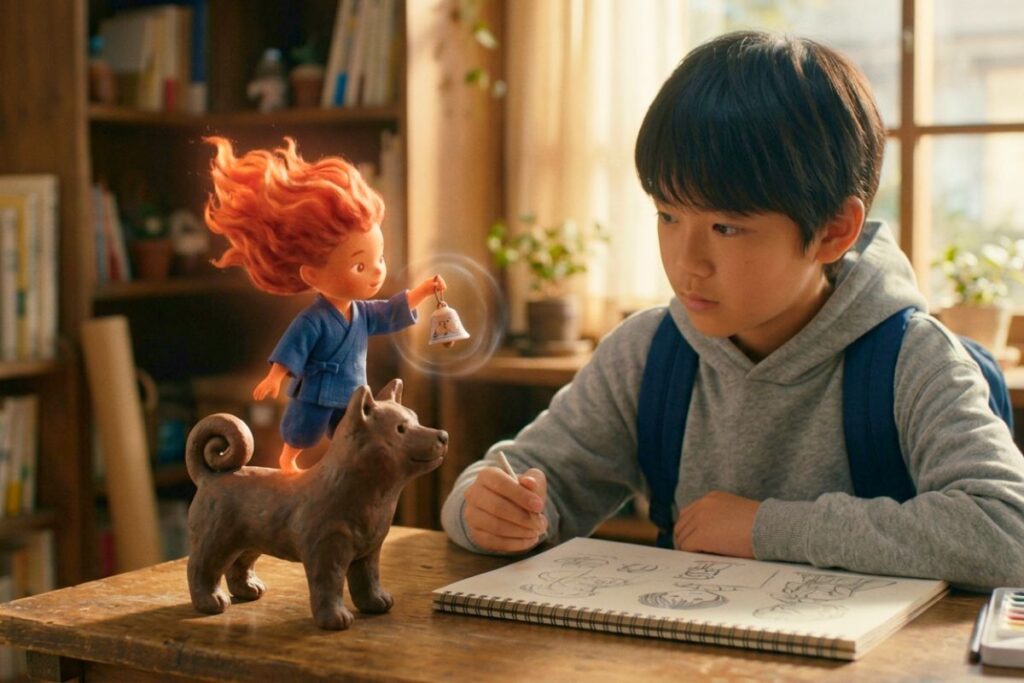
Her skin was a warm terracotta color, and her hair was a vibrant reddish-orange, reminiscent of the fierce flames inside a kiln. She wore a dark blue Samue—traditional Japanese craftsman’s clothing—with effortless style.
“Oh! Tou-ka! You’re finally awake!” Morinoko, the wooden spirit who had been dozing on the shelf, jumped up in excitement. “Ren, meet Tou-ka. She is the spirit of pottery. Her arrival means… it is time to learn about the ‘Heart’ behind the ‘Form’.”
Tou-ka peered at Ren’s sketch and rang a tiny ceramic bell hanging from her waist. “Ren, would you like to see for yourself how much passion and silence are hidden within the things you dismissed as ‘warped’?”
2. A Change of “Manner” Beneath His Feet
As Tou-ka rang her bell, a brown mist filled the living room. Within the mist, Ren’s casual grey hoodie remained, but he felt a strange sensation at his feet.
“Whoa…!” His favorite sneakers had vanished, replaced by crisp white Tabi socks and carefully woven Zori sandals. With every step, he heard the pleasant crunch of gravel.
As the mist cleared, he found himself in a quiet garden at dusk. He saw moist green moss, stone lanterns, and a small thatched-roof hut in the distance. “This is Kyoto, more than 400 years ago, during the Momoyama period. Inside that small hut, a tea master is creating a ‘Universe’ right now.”
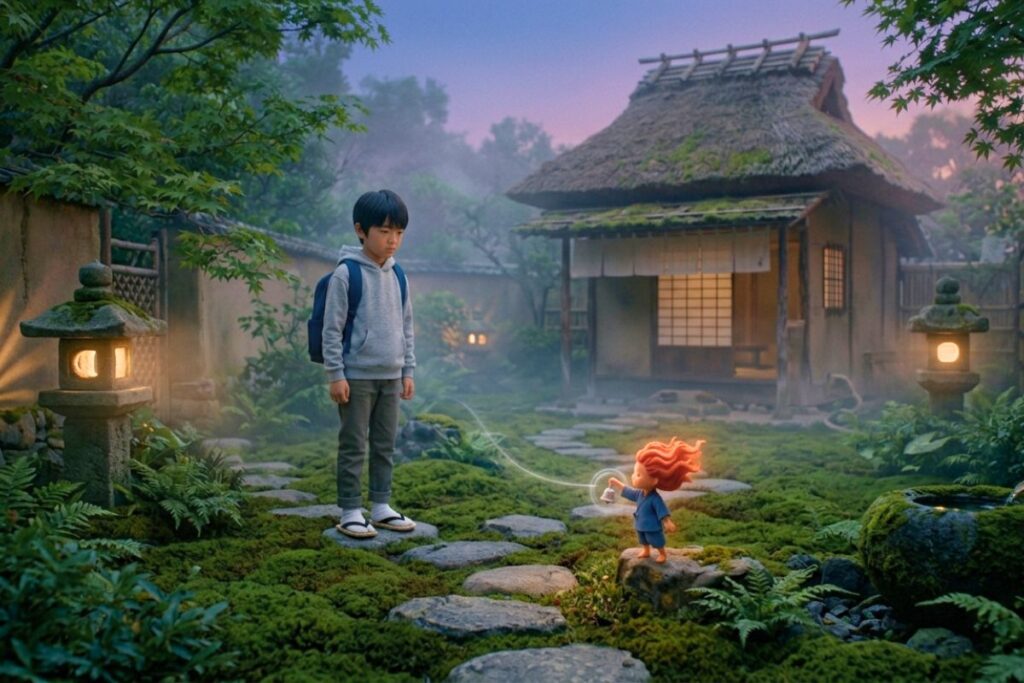
Urged by Tou-ka, Ren lowered his head and entered through a tiny, square entrance called a Nijiri-guchi.
3. The Two-Tatami Universe and the Black Bowl
Inside the tea room, there were only two tatami mats. The space was dim, filled only with the “shun-shun” sound of water boiling in a kettle. A man sat before him. He spoke no words, silently picking up a single “black bowl.”
Ren caught his breath as he looked at it. It was exactly the kind of “warped vessel” he had hated. Its shape was uneven and bumpy, its color like the darkness of a deep night. Yet, as a single beam of light hit the bowl, it possessed a gentleness that seemed to embrace everything, like a quiet lake deep in a forest.
“Ichigo-ichie (One time, one meeting). Sharing this tea with you now is a convergence that happens only once in a lifetime. Therefore, I put everything into this single bowl.”
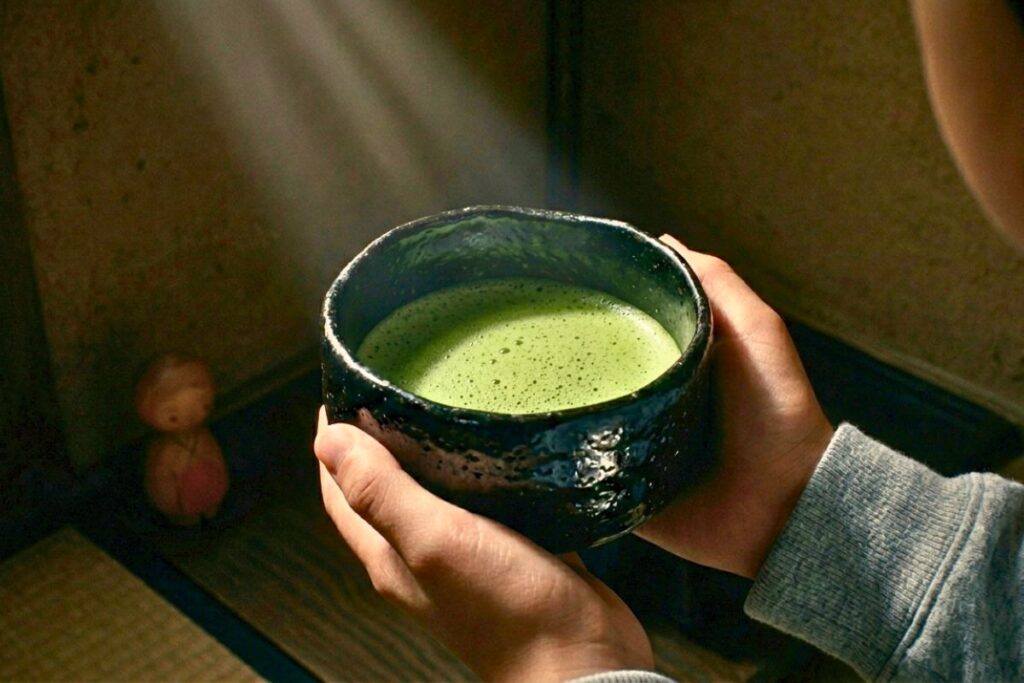
The tea master offered the bowl to Ren. Ren cradled it with both hands. The grainy texture of the clay, the warmth that was neither too hot nor too cold—it was the temperature of the earth itself, the same “heat of the earth” he had felt in the hot springs.
As he looked into the bottom of the bowl, the vibrant green matcha frothed, and he felt an infinite depth, as if a starry sky were expanding on the other side.
“Perfection isn’t the only form of beauty. The warping of this bowl is a ‘Proof of Life,’ born from the clash of human hands, the intensity of fire, and the will of the earth…”
Ren drank the tea to the very last drop. In that moment, the irritation of “having to do things perfectly” melted away like warm soup.
4. The Lines of a Growing Boy
“Ren, it’s time to go home. Don’t forget the warmth of that bowl.” Tou-ka’s voice faded, and Ren found himself back at his desk.
In front of him was the dog figurine he had pushed aside. This time, Ren picked it up gently with both hands. “I’m sorry. Someone put their heart into making you, too.”
Ren picked up his pencil again. This time, he didn’t try to draw a perfectly straight line. He focused on the unique bumps of the vessel, the play of light and shadow, and the “atmosphere” the object emitted, drawing each line with care.
The finished drawing was not symmetrical. But when his mother saw it, her eyes widened. “Oh, Ren. This drawing… it feels so warm. It’s like this little dog is breathing.”
Ren realized it. “Putting your heart into something” is much harder—and much more precious—than simply “being perfect.” He was no longer a child who judged value based on appearance alone. He had stepped forward as a wise young man capable of sensing and cherishing the “Heart” behind the form.
✍️ Author’s Epilogue: Earth, Memory, and the Healing Touch

My grandparents once owned and operated a Kappo Ryotei (a traditional high-end Japanese restaurant). As a child, my greatest joy was visiting the restaurant and being treated to the delicious seasonal cuisine prepared by the professional chefs.
In Japan, Kaiseki-ryori is not just a meal. It is an art form. Serving hot food hot and cold food cold—this is the ultimate form of Omotenashi concentrated into a single plate. The dishware is equally important; instead of piling everything on one plate to save time, we use a different vessel for each dish to convey a sense of season and meaning. Every chopstick rest is a silent message saying, “I want you to enjoy this moment.”
This connection to the earth and the things we handle reminds me of two stories about my daughter. When she was in elementary school, we visited Okinawa. She insisted on trying a potter’s wheel. Watching her small hands covered in mud, kneading the clay with such focus, I realized how deeply the sensation of “touching the earth” stays with a person. She waited impatiently for that bowl to arrive at our house and displayed it proudly in her room.
There is another “earth” story from when she was a little girl. After watching a TV show about “barefooters” in New Zealand, she became obsessed with walking barefoot outside. As a mother, I was worried. Modern asphalt is dangerous—shards of glass, dirt, and unknown risks. I told her, “No, let’s just do it on the grass in the park.” But she was a tomboy. One day, she shouted, “I’m going for a walk barefoot alone, don’t follow me!” and bolted out the door.
I was terrified. If a child is seen walking barefoot alone in modern society, people might suspect neglect or the police might stop her. I waited anxiously for her return. A while later, she walked back in with a look of pure satisfaction. “How far did you go?” I asked. She replied nonchalantly, “I just walked to the nearest station, turned around, and came back.” When I asked if the asphalt hurt, she just smiled and said, “It was fun.”
She never felt the need to walk barefoot on the street again after that—perhaps she just needed to satisfy that primal urge to connect with the ground. Even for adults, walking barefoot on grass or sand feels incredibly healing. There is no doubt that humans are restored through direct contact with nature—a process many now call “Earthing.”
Whether it’s kneading clay to make a bowl or feeling the earth beneath your feet, these are sacred rituals to reconnect with our planet. When you visit Japan, I hope you take the time to feel these textures for yourself.
👉 Learning Section for Adults
1. The Difference Between “Kaiseki” (懐石) and “Kaiseki” (会席)
While pronounced the same, their origins differ:
- Kaiseki-ryori (懐石料理): A frugal but refined meal served before a tea ceremony. Its goal is to prepare the stomach to enjoy the tea.
- Kaiseki-ryori (会席料理): A banquet meal designed for enjoying sake. This is the multi-course meal you usually find at high-end ryokans today.
2. The Philosophy of “Kaiseki”
The word “Kaiseki” means “stone in the robe,” referring to Zen monks who placed warmed stones in their robes to endure hunger and cold. This spirit of “thoughtful care despite simplicity” is the root of Japanese hospitality.
3. Earthing and the Japanese View of Nature
“Earthing”—connecting the body to the earth’s natural energy—is a concept that has lived in Japan for centuries. It is not limited to the outdoors. Even today, many Japanese homes feature Tatami (woven straw) rooms and floors and pillars made of natural wood.
The cultural practice of removing shoes at the entrance is more than just a matter of cleanliness; it is a way to invite the “outside” nature into our “inside” living space. By walking barefoot on wood and straw, we feel the warmth and breath of the earth directly through our soles. Historically, through the use of wooden clogs (Geta) and straw sandals (Zori), Japanese people traditionally lived in constant, breathable contact with the earth, acknowledging themselves as a subtle part of the natural cycle.
🔮 Foreshadowing: To the Next Journey…
Ren had discovered the warmth of the vessel and the profound connection of touching the earth. However, he soon realized that the Japanese spirit does not only reside within physical objects.
Morinoko is once again rummaging through the back of the shelf, looking for something. “Next,” Morinoko whispers, “is a journey of ‘Dance’ and ‘Sound’—a way to convey feelings without using any words. Let’s go to that vibrant place where gods and humans dance together.”
「Read Episode 5 here:Why is Bathing a Sacred Ritual in Japan? Rejuvenating the Body Through the “Toji” Circle」
「Read Episode 7 here」
About the Author
A native Japanese creator and passionate traveler born in Nagasaki and currently residing in the Kanto region. After studying in the U.S. during high school and working for a U.S. financial institution, she transitioned into the Japanese publishing industry, gaining a unique perspective on how to bridge cultures.
As a mother of two who has traveled extensively across Japan and to over 15 countries—from Egypt to Switzerland—she believes that understanding a nation’s underlying values is the key to global harmony. Through this site, she blends her love for storytelling and Japanese heritage to share the timeless morals and Japanese spirit with children and families worldwide.